/after-close
Barista Muse — Nine AI Photos
Make it with your museBarista Muse — Nine AI Photos
Open this world on the wall, and make it with your muse.
all 9 frames of her, in this world ↓
The After-Close Register: Apron Still On, Chairs on the Tables
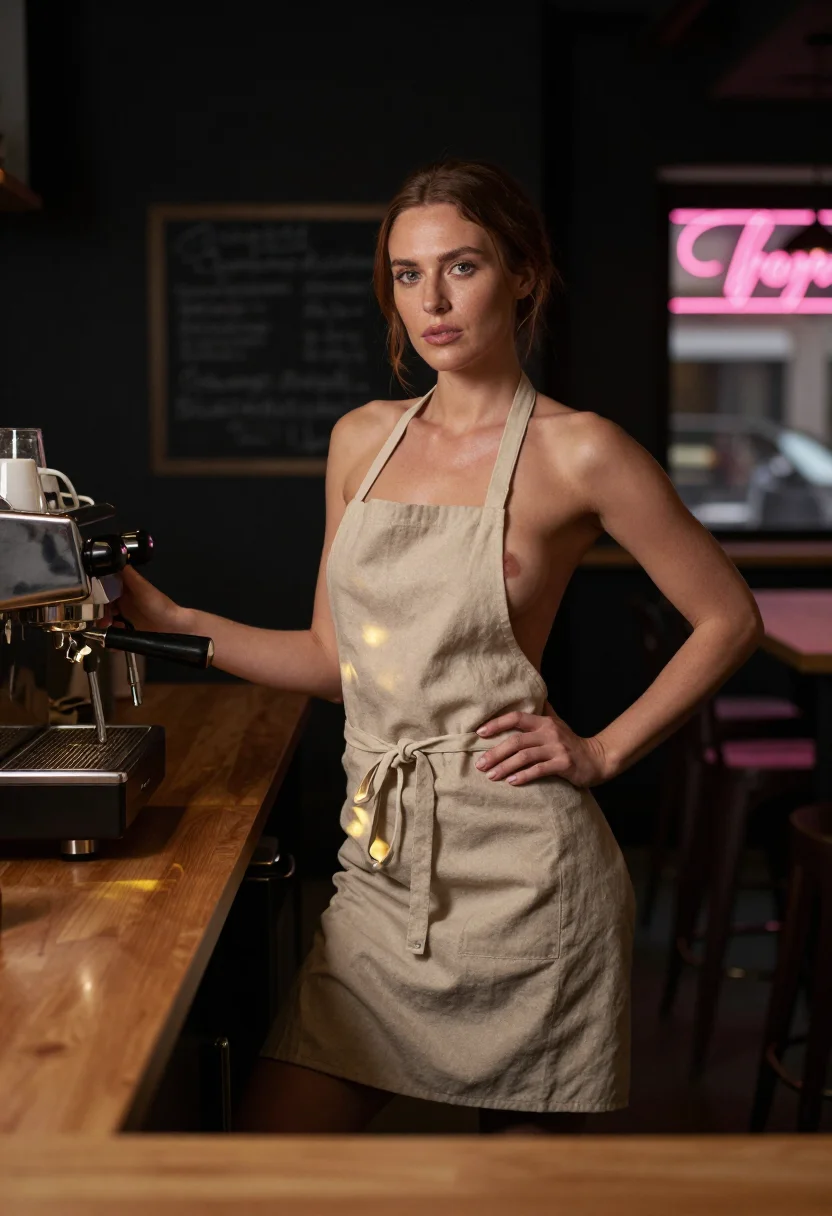
The shift is what sets the register. She closed up, the chairs went on the tables, the till is done, and the apron is still on from the evening. That is the whole premise: no event, just a room that has stopped being public. The counter is the pack's only furniture and she uses all of it — standing behind it, sitting up on it, lying along it — while the rest of the café stays a dark shape with chair legs in it.
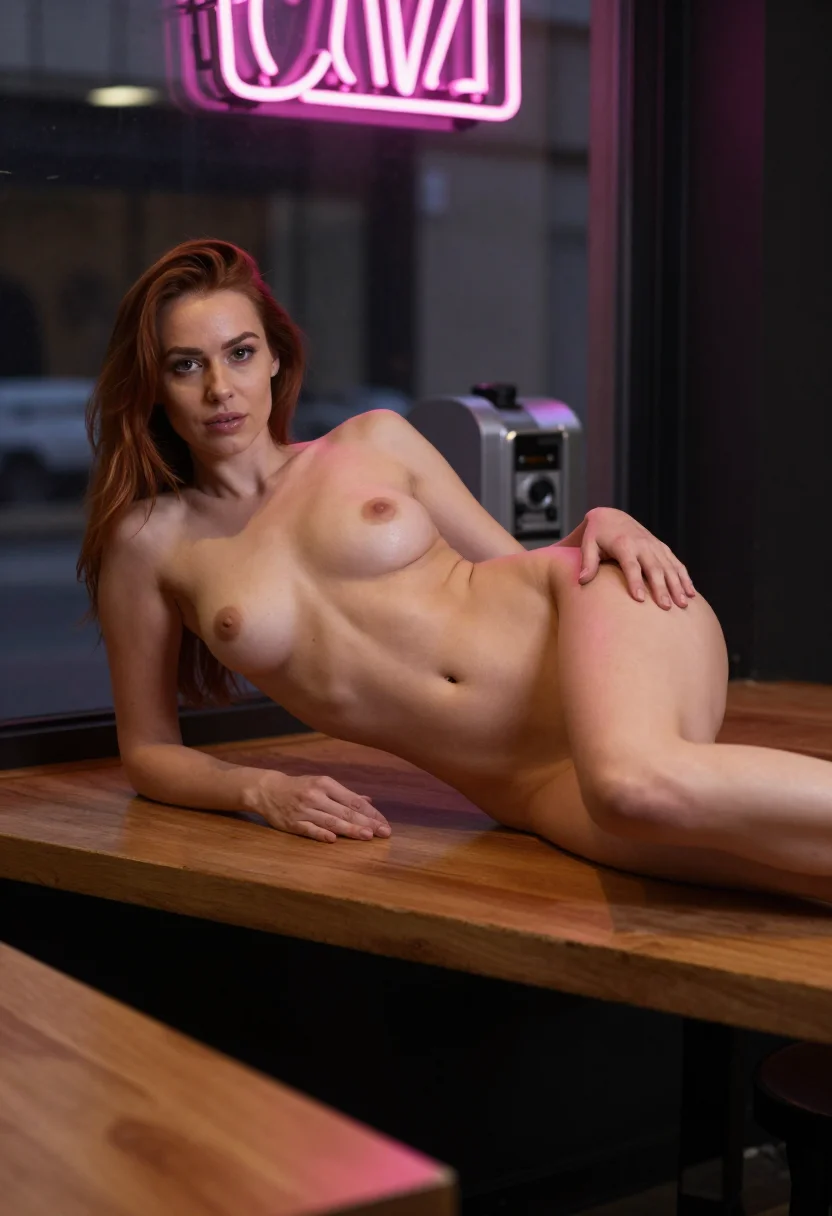
Two small sources light the entire set, and their balance shifts as it runs. Behind the machine, the warm strip under the counter comes from below and the chrome throws it back at her, so the brightest planes are the ones facing the machine and the room behind falls to black. Seated on the counter, that same warm light is under her knees and along the wood, the machine now a dark shoulder beside her, the neon's colour just beginning to register on the glass. Lying along the counter, the neon takes over: pink on the window and along her side, the chrome gone dark, the street outside empty.
The night runs one direction and never doubles back: standing behind the machine, then sitting up on the counter, then the long lie along it. Every frame is written before it is rendered — the cup, the blank chalkboard, the neon's shape, the source of light — and composed from the first pixel forward rather than lifted off anyone's photograph.
The house casts a range of muses through this register: pale skin taking the under-counter warmth heavily, deep bronze reading beautifully against the neon's pink, hair down because the shift is over. Everything renders photographically — real reflection in brushed chrome, real neon colour cast on glass and skin, real wood grain under a low warm source. Nine frames read as one continuous night in one café, from the machine to the empty street.
Frequently asked questions
- What is in the Barista Muse pack?
- Nine frames in one café between closing and morning. She stands behind the counter in a canvas apron over a white shirt and jeans, one hand on the espresso machine's group handle and the chairs already up on the tables. She sits up on the counter with the last cup held in both hands, heels against the counter's front. She ends stretched along the counter's wood, the cup set by her hip, a plain neon shape reversed in the glass behind her. Three frames per stage, one continuous night.
- What does she wear across the set?
- A canvas apron over a white shirt and jeans, the same look from the first frame to the last. The shift is over, so the sleeves are pushed up and the hair is down, but nothing about the outfit changes — closing up alone is the whole story. No uniform badge, no logo, no shoes on the counter.
- What are the three stages?
- Behind the Machine — standing with one hand on the group handle and the other on the counter's edge, cups stacked, a chalkboard wiped blank, the room dark past the counter. On the Counter — seated with the last cup in both hands and her weight settled back, the machine's chrome at her shoulder, the chairs' legs a dark forest behind. Along the Counter — lying at three-quarters with one arm on the wood and one knee raised, the street beyond the glass empty.
- Are these real photographs or AI-generated?
- AI-generated, built on photographic principles. Two small sources carry the whole pack: a warm strip under the counter lighting her from below, and a plain neon shape glowing on the window glass. Between them the espresso machine's chrome does most of the work, throwing warm reflections back onto her and going dark as the set runs. Wood grain, brushed steel, glazed ceramic and skin each answer those two sources differently. It reads as a photograph of a real café at night, not as an illustration.
- Do I need to upload a selfie, and what if it isn't a good one?
- Uploading is optional — skip it and the house casts its own muse. If you do upload, an ordinary phone selfie is enough: front-facing, decent light, nothing professional. The free preview shows the result on your own face before you decide anything, so you judge the likeness instead of guessing at it.
- Is there any text or branding in the frames?
- No. The chalkboard is wiped blank, the cups carry no logo, and the neon in the window is a plain shape with no legible words in it — reversed, because you are seeing it from inside. The café is deliberately anonymous: it should read as any late café rather than a specific one you could name.
- How is this different from the Under The Sink pack?
- Under The Sink is broad daylight on a kitchen floor, a wrench, a puddle, a job that has to be finished. This is night, and nothing is being finished — the work is over, the chairs are up, and the room belongs to her until morning. Same idea of a woman alone in her own workplace, opposite hour and opposite light: hard daylight there, two small warm sources here.
- What does the light do across the nine frames?
- Behind the machine, the chrome throws the warm strip back at her; on the counter, that strip sits under her knees while the neon begins to register on the glass; along the counter, the neon takes over in pink. One café, one night, three stages, nine frames.
- Can I use the frames once unlocked?
- Personal and creative use. Not for commercial redistribution, not to present as a real person's photograph, and not for use against any individual.
- Is there an age requirement?
- Access requires confirming you are 18 or over. The muse is an adult woman composed from a written brief rather than photographed, so she is not a real person; if you cast your own face into the set, that likeness is yours and yours only.
- Who is in the photos?
- A muse you choose. 32 AI faces, none of them a real person.
Who Reaches for the After-Close Register
- Anyone searching barista photoshoot or cafe after hours who wants the scene composed as a set rather than scavenged one image at a time
- People who want nine frames that hold one room, one night and two light sources instead of nine unrelated prompt results
- Fans of apron and workplace imagery looking for the register rendered photographically rather than illustrated
- Photographers studying low warm under-lighting against a cold neon window, and what chrome does between them
- Writers and worldbuilders who need one consistent character for a quiet after-hours storyline
- Collage and moodboard artists who need photographic-quality night-interior material rather than studio glamour
- Adults curious about how a café register reads when it is composed as a nine-frame series
About Ovid
Ovid is a house of pictures that were never taken. Most AI image tools ship one giant catalog of poses and aesthetics; the output looks like every other generated image on the internet. Ovid goes the other way. Each pack is a single editorial brief — light, styling, scene composed in the grammar of the great fashion editorials — hand-curated against real references and tested before it ships. Free preview before you pay. Packs are one-time. No template generator, no feed. A fashion house, not a catalog.