/android-assembly
Android Assembly Muse — Nine AI Photos
Make it with your museAndroid Assembly Muse — Nine AI Photos
Open this world on the wall, and make it with your muse.
all 9 frames of her, in this world ↓
The Assembly Register: Open Panels, Closing Seams, First Rain
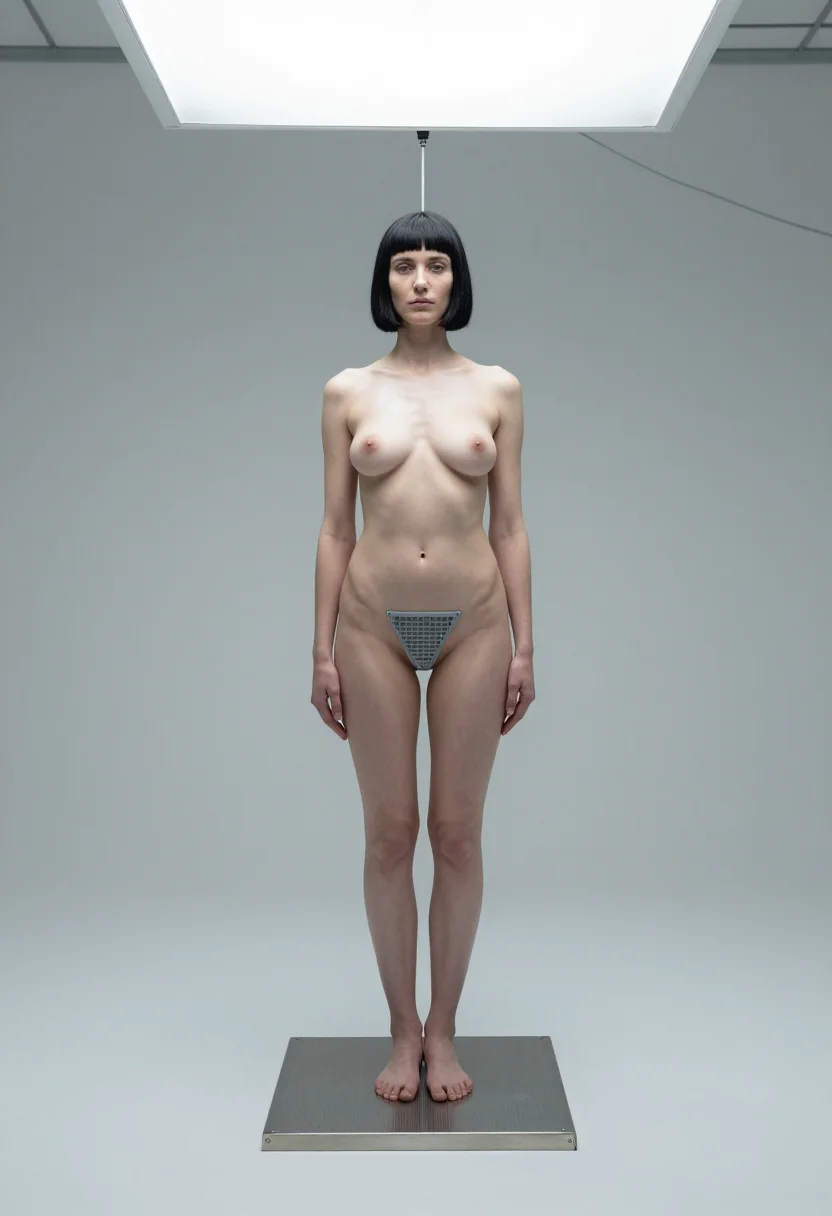
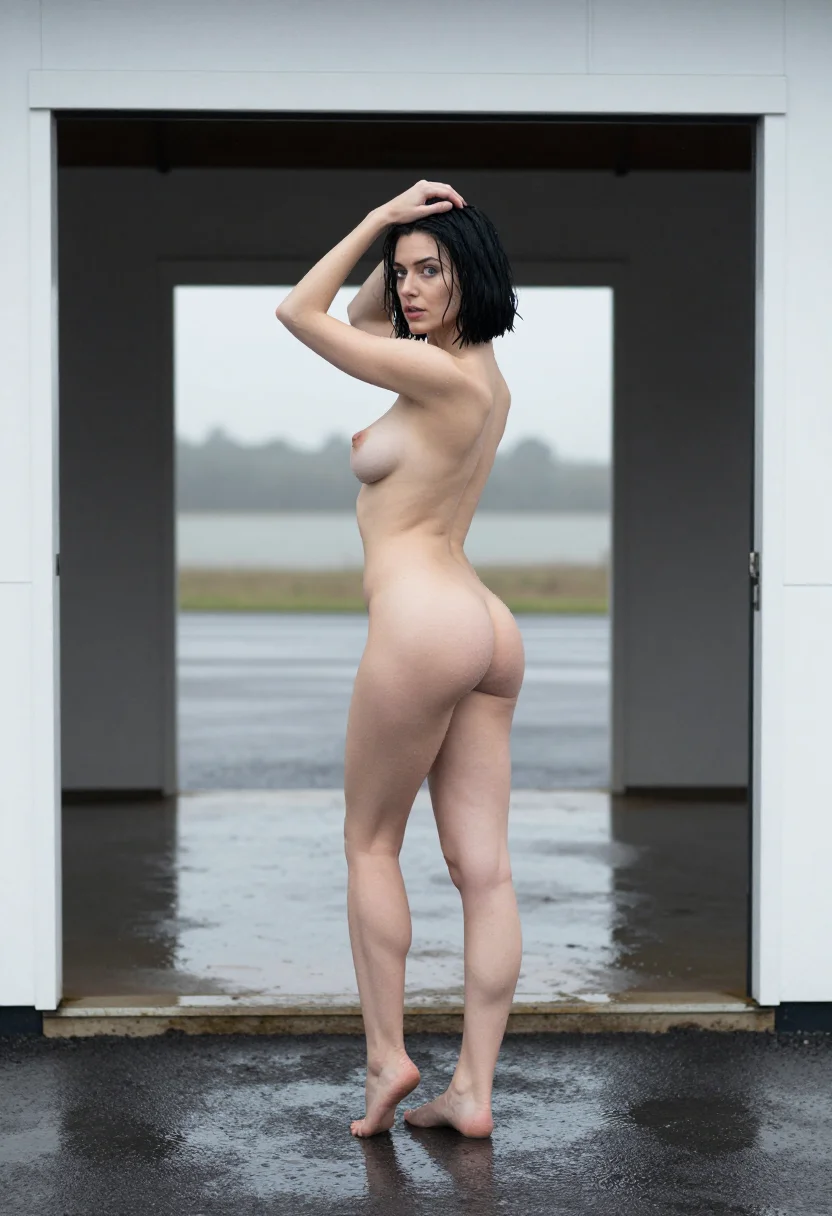
A white assembly bay with a raised plate at its centre, cable trays overhead and a roll-door at one end standing open on wet tarmac. The subject is a newly built woman photographed across the minutes in which her body finishes: service panels open on the frame beneath, then sealed to faint traces, then complete and standing in weather for the first time. She wears the same pale grey technical bodysuit throughout — what changes across the nine frames is how much of her is closed.
Three lights carry the sequence and they cool as it runs. It opens under the bay's flat white panel light, broad and nearly shadowless, the open service panel reading as a clean rectangle of grey lattice against the suit and the cables running in a straight line from the ceiling to a port at her nape. It moves to a softer light from one side, where the sealed seams at shoulder and hip show only because the light rakes across them, one forearm in brushed chrome from wrist to elbow resting on her thigh and the frame-mould standing empty at the edge of shot. It closes at the roll-door, where cold grey daylight and wet tarmac meet the warm bay light behind her and rain blows in over the threshold onto her feet.
The mechanical vocabulary is deliberately thin — an open abdomen panel, a chrome forearm, a nape port, a seam line. Each is named once and never elaborated, one noun per limb, so the frames stay photographs of a woman rather than diagrams of a machine. Every pose is standing or seated with a hand on the plate or the door's steel edge; nothing is aimed at the lens; no hands and no faces other than hers appear anywhere in the bay.
The house casts a range of muses through this register — pale skin taking the panel light almost flat, deep bronze holding a warmer edge against the door's grey daylight, hair kept off the nape where the cables seat. Every frame renders photographically: real specular on chrome, real matte on the frame's grey lattice, real soft falloff at the roll-door threshold, real rain on a wet floor. Nothing here was lifted from a photograph of anyone. Each frame is written before it is rendered — the plate, the panel, the source of light, the open door — and composed from the first pixel forward.
Frequently asked questions
- What is in the Android Assembly Muse pack?
- Nine frames in one white assembly bay, in a close-fitting pale grey technical bodysuit throughout. Three standing on the raised assembly plate under flat panel light, the last service panels still open on the frame's grey lattice beneath, technicians' cables running from the ceiling to a port at her nape. Three seated on the plate's edge with the panels sealed and the seam lines still readable as fine pale traces at shoulder and hip, one forearm in brushed chrome from wrist to elbow. Three at the open roll-door, complete, with rain blowing in over the threshold onto her feet.
- Does this pack edit or alter a real photograph?
- No. Nothing is lifted from an existing image, because no existing image is read. Each frame is written first — the plate, the open panel, the cable run, the wet tarmac beyond the door — and composed from the first pixel forward. She is a synthetic woman by construction as well as by story; if you upload a selfie, that likeness is yours by choice, cast into a muse written before she was rendered.
- How much of her is mechanical?
- Little, and it is named rather than sprawled. Four attachments carry the whole pack: an open service panel showing the frame's grey lattice, one forearm in brushed chrome from wrist to elbow, a port at the nape where the cables seat, and the seam lines that stay faint once the panels close. One noun per limb, no more — the register is a figure being finished, not a machine costume.
- Are these real photographs or AI-generated?
- AI-generated, built on photographic principles. The bay's white panel light is broad and nearly shadowless in the first third and comes from one side by the second, so the seam traces read only at a raking angle; at the roll-door, cold grey daylight from outside meets the warm bay light behind her and the wet tarmac throws its own bounce. Skin, chrome and the frame's grey lattice each answer that light differently. It reads as a photograph of a real bay, not an illustration.
- What are the three stages?
- Open — standing on the assembly plate, service panels open on the frame beneath, cables from the ceiling to the nape port, arms relaxed at her sides. Sealed — seated on the plate's edge, panels closed with the seams as pale traces, one chrome forearm resting on her thigh, cable ends coiled beside her and the empty frame-mould standing at the edge of shot. Activated — complete in the open roll-door on the rain, one hand on the door's steel edge, the cables retracted to the ceiling.
- Is anyone else in these frames?
- No. Cables come down from the ceiling and tools sit at the frame edge, but no hands and no faces appear anywhere in the pack. The bay is empty apart from her — the work is finished and what is left is the first minute of her own body.
- How is this different from the Maintenance Bay pack?
- Maintenance Bay is the same species of figure some time later: a padded steel bench, warm task lamps, a coverall worn for the work and a back plate lifted for access. This one is the beginning — a white bay, cold flat panel light, panels that have never closed before and a door she has never walked through. Assembly versus service.
- How is this different from the Charging Dock pack?
- Charging Dock is the domestic end of the same idea — a dark kitchen at night, a household robe, a wall dock and a nape port lit steady blue while the house sleeps. This one is the factory end, hours earlier in her life: white light, cables from the ceiling, the frame-mould still standing empty behind her.
- What if my photo isn't great?
- The pack works with an ordinary phone selfie — front-facing, decent light, nothing professional required. The free preview shows the result on your own face before you commit to anything.
- What does the bay look like?
- A white assembly bay with a raised plate at its centre, cable trays overhead and a roll-door at one end standing open on wet tarmac. One bay, three stages of a figure closing, nine frames that hold together as a set.
- Can I use the frames once unlocked?
- Personal and creative use. Not for commercial redistribution, not to present as a real person's photograph, and not for use against any individual.
- Is there an age requirement?
- Access requires confirming you are 18 or older. The muse is composed from a written brief rather than photographed, so she is not a real person; if you cast your own face into the set, that likeness is yours and yours only.
- Who is in the photos?
- A muse you choose. 32 AI faces, none of them a real person.
Who Reaches for the Assembly Register
- Anyone searching android girl or gynoid photos who wants the register composed rather than scavenged
- People who want a coherent nine-frame set across one bay instead of one-off prompt results that never match
- Fans of android and synthetic-woman science fiction looking for it rendered as photography rather than illustration
- Photographers studying flat panel light against a cold daylight threshold in one continuous sequence
- Concept and prop designers looking at how a chrome forearm and an open panel sit against a human face and hands
- Writers and worldbuilders who need one consistent synthetic character from build to first activation
- Fans of the Maintenance Bay and Charging Dock packs collecting the same body at three points in its life
- Collage and moodboard artists who need photographic-quality white-bay material rather than studio glamour
- Adults curious about the gynoid register of AI photography at an accessible entry price
About Ovid
Ovid is a house of pictures that were never taken. Most AI image tools ship one giant catalog of poses and aesthetics; the output looks like every other generated image on the internet. Ovid goes the other way. Each pack is a single editorial brief — light, styling, scene composed in the grammar of the great fashion editorials — hand-curated against real references and tested before it ships. Free preview before you pay. Packs are one-time. No template generator, no feed. A fashion house, not a catalog.