/atelier-muse
Artist Muse — Nine AI Photos
Make it with your museArtist Muse — Nine AI Photos
Open this world on the wall, and make it with your muse.
all 9 frames of her, in this world ↓
The Atelier Register: North Light, the Painter Gone to the Café
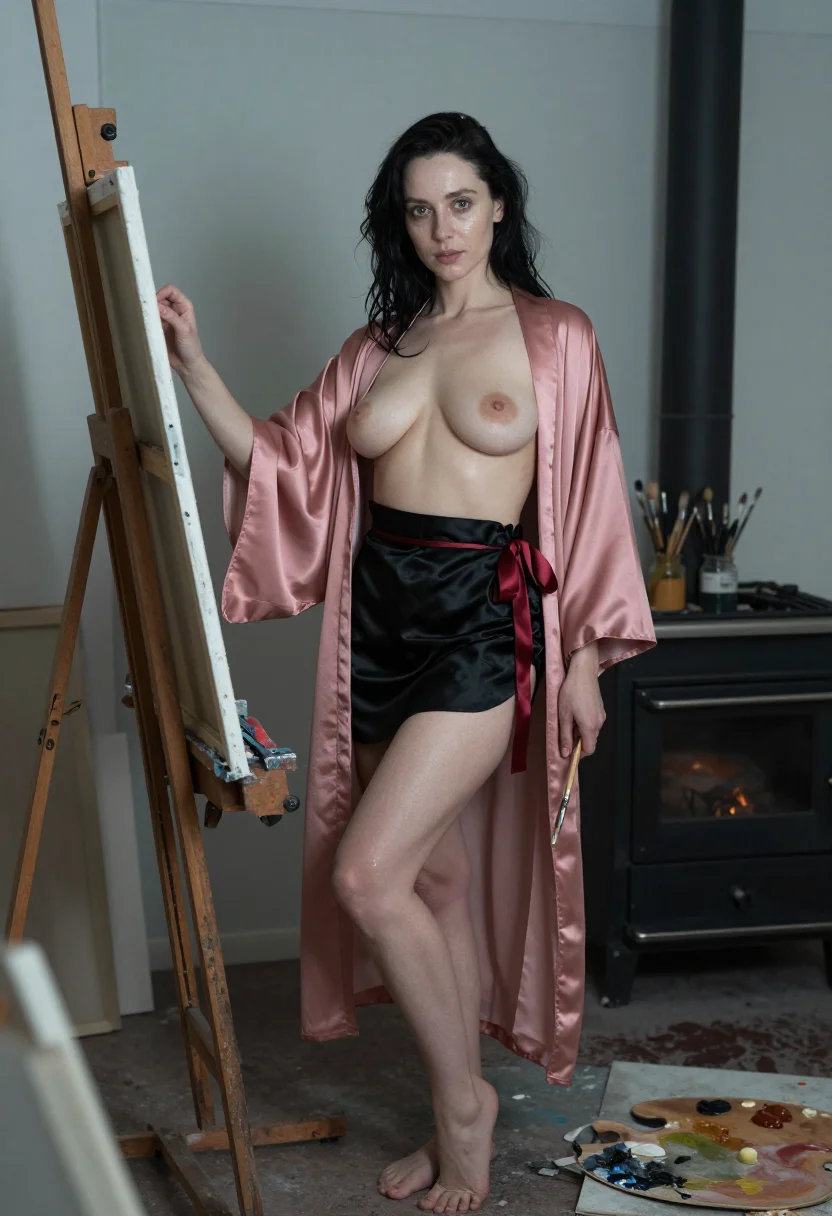
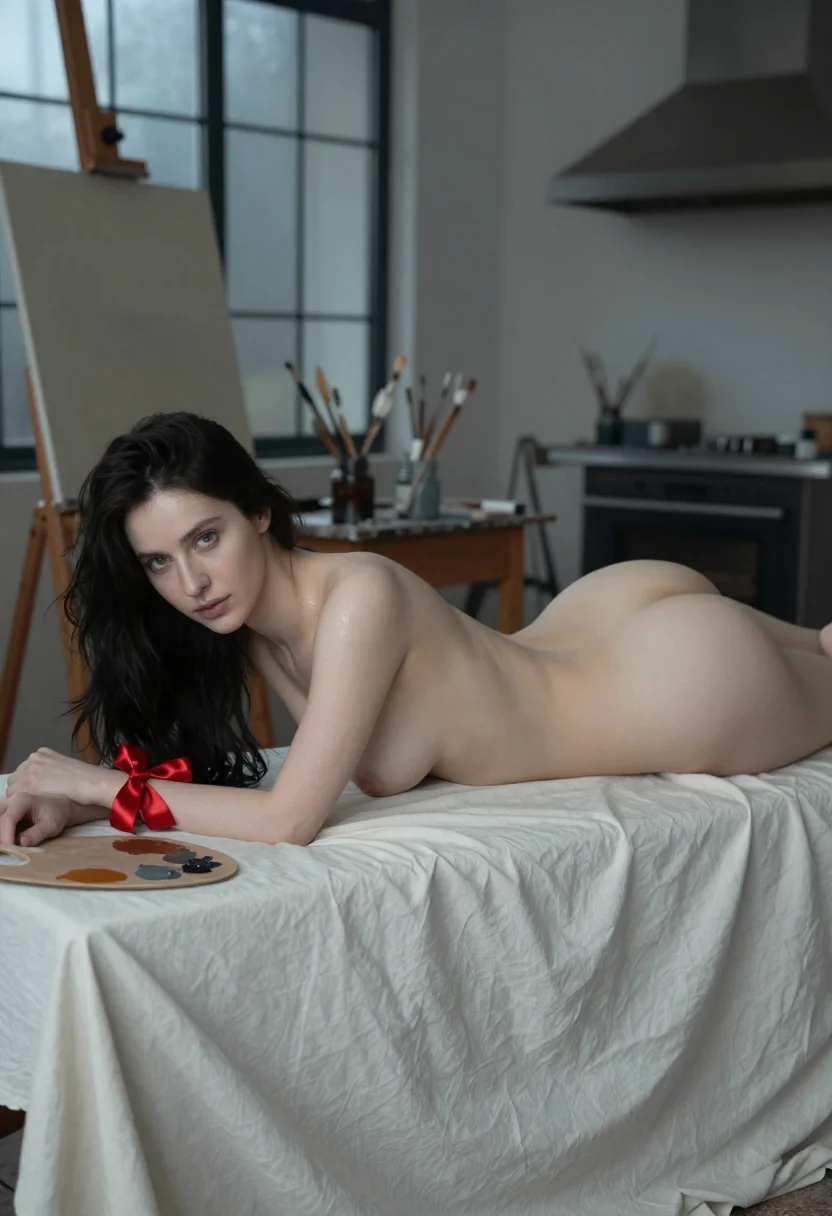
The pack sits inside a Montparnasse painter's atelier, the register the word muse comes from — a studio built to be looked at in, north light through a wall of glass, jars of brushes and turpentine, a dropcloth chaise, a wet canvas with her half-painted. The register is studio photography rather than a costumed set: cool even light, paint-spattered boards, a stove in the corner, and the painter absent for the length of the afternoon. Casting stays constant across all nine frames: a woman in her late twenties, dark hair loose, a red ribbon at the wrist.
Three stages run the set and the poses change with them. By the easel: the faded silk kimono worn open over a black slip dress, barefoot, a brush in one hand, the wet canvas showing her half-painted. Seated on the dropcloth chaise: the kimono left on its arm, weight back on one hand, the ribbon at the wrist catching the light. Reclining on the chaise's dropcloth: the kimono across her knees, one arm under her head, framed from the head end toward the canvas.
One light source carries the whole sequence — the wall of glass's cool north light, the exact light Montparnasse studios were built around for a century. All nine frames are photographic in construction and AI-generated in execution: shadow edge, fabric behaviour and skin rendered from photographic principles, not drawn and not animated. No real person or real atelier was photographed to make any of them.
Frequently asked questions
- What is in the Artist Muse pack?
- Nine frames across one afternoon in a Montparnasse atelier. Three by the easel in a faded silk kimono worn open over a black slip dress, barefoot, a brush in one hand, the wet canvas half-painted behind her. Three seated on the dropcloth chaise, the kimono over its arm, the slip dress kept on, a red ribbon at the wrist. Three reclining along the chaise's dropcloth in the wall of glass's light, the kimono draped across her knees. Three frames per stage, one payment for the set.
- Are these real photographs or AI-generated?
- AI-generated, built on photographic principles. The whole set runs on one wall-of-glass north light — cool, even, the register every atelier photograph is built around — with jars of brushes and turpentine and a stove sitting at the frame's edge throughout. It reads as a studio photograph, not as an illustration.
- What is she wearing, stage by stage?
- First the faded silk kimono worn open over a black slip dress, barefoot on the paint-spattered boards, a red ribbon already at the wrist. Then the kimono over the chaise's arm, the slip dress kept on, seated with weight back on one hand. Then the same slip dress, the kimono across her knees, lying along the dropcloth in the glass wall's light. Each stage is a settled pose, never a half-motion.
- Where is the painter?
- Gone to the café — the whole premise of the register. The wet canvas on the easel shows her half-painted, the brush still in her own hand rather than the painter's, and the afternoon left to her alone until he comes back. It is the muse's work, not a painter's session, that the frame is built around.
- What does the canvas show?
- Her, half-finished, in the colours the painter was working when he left — the wet canvas sits in every frame's background, in soft focus, a working object rather than a finished picture. Nothing on it is ever clearer than the room around it.
- Do I need to upload a selfie?
- It is optional. One clear front-facing photo casts the muse in your likeness across all nine frames; skip it and the house casts its own. Your selfie steers the face — it is never the image being altered.
- What is the light like in the atelier?
- One source carries the whole afternoon: cool, even north light through the wall of glass, with jars of brushes, turpentine and a stove at the frame's edge. One atelier, one afternoon, nine frames that hold together as a set.
- Can I use the frames once unlocked?
- Personal and creative use. Not for commercial redistribution, not to present as a real person's photograph, and not for use against any individual.
- Is there an age requirement?
- Access requires confirming you are 18 or over. The muse is an adult woman composed from a written brief rather than photographed, so she is not a real person; if you cast your own face into the set, that likeness is yours and yours only.
- How is the recline framed?
- From the head end, at three-quarters, one arm under her head and the other hand on the dropcloth at her hip — the composition looks along her length toward the wet canvas rather than up at her toward the lens.
- Who is in the photos?
- A muse you choose. 32 AI faces, none of them a real person.
Who Reaches for the Atelier Register
- People searching artist muse or painter's model photos who want the working-studio register rather than a generic portrait set
- Photographers studying how a wall of glass's cool north light renders paint-spattered boards, silk and skin together
- Painters and illustrators who want painter's-model reference across a standing, seated and reclining sequence
- Writers and worldbuilders who need one atelier muse across a coherent three-stage afternoon
- Collage artists who need photographic-quality studio material rather than a costumed set
- Anyone building a painter's model moodboard that has to hold one grade across a whole atelier scene
- Fans of the fine-art-studio register curious what an AI version of the classic muse looks like
- Adults curious about the atelier register of AI photography
About Ovid
Ovid is a house of pictures that were never taken. Most AI image tools ship one giant catalog of poses and aesthetics; the output looks like every other generated image on the internet. Ovid goes the other way. Each pack is a single editorial brief — light, styling, scene composed in the grammar of the great fashion editorials — hand-curated against real references and tested before it ships. Free preview before you pay. Packs are one-time. No template generator, no feed. A fashion house, not a catalog.