/bengali-boudi
Bengali Boudi Muse — Nine AI Photos
Make it with your museBengali Boudi Muse — Nine AI Photos
Open this world on the wall, and make it with your muse.
all 9 frames of her, in this world ↓
The Bengali Boudi Register
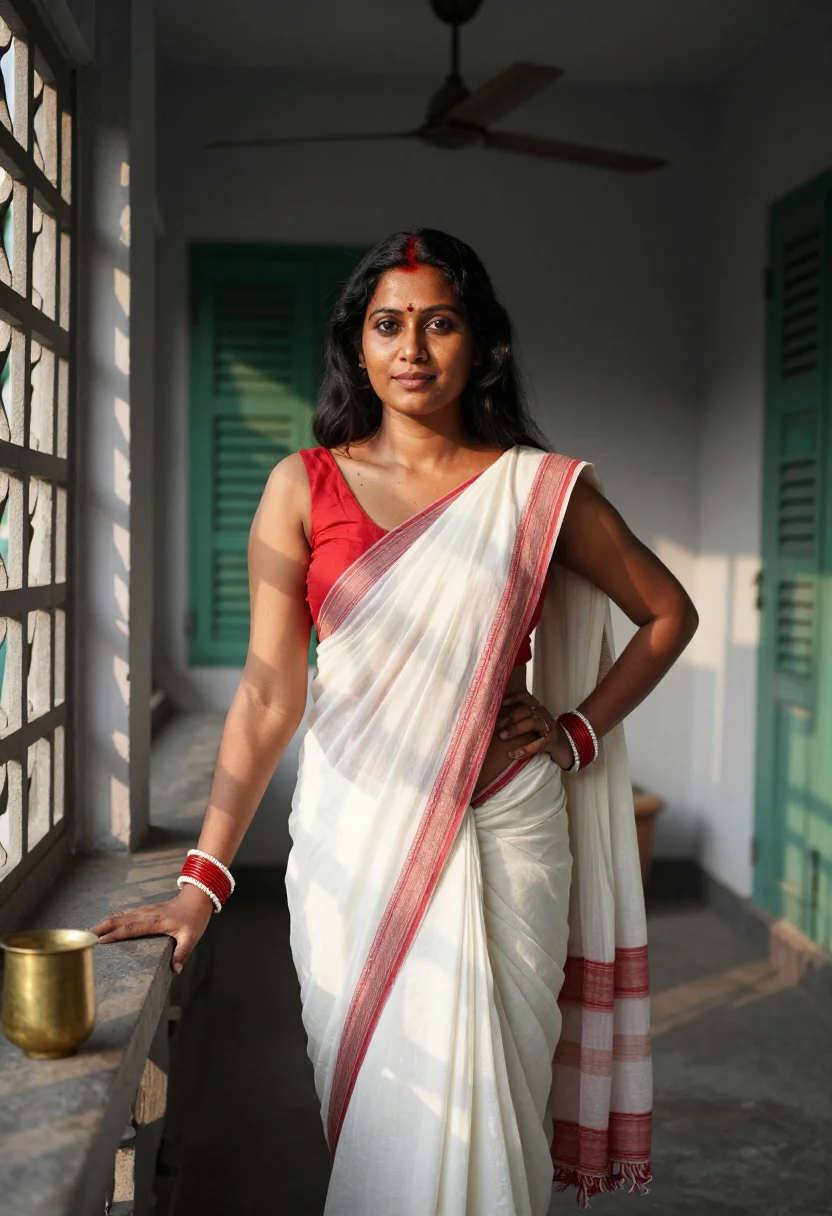
This is the boudi of Bengali domestic fiction — the neighbour's wife, married, unhurried, alone in the house between the morning market and the evening return. The register borrows from the para lane itself: a jute-string cot on the veranda, a ceiling fan turning slow through a load-shedding lull, betel leaves in a brass box, hard afternoon light through a lattice throwing diamonds on plaster.
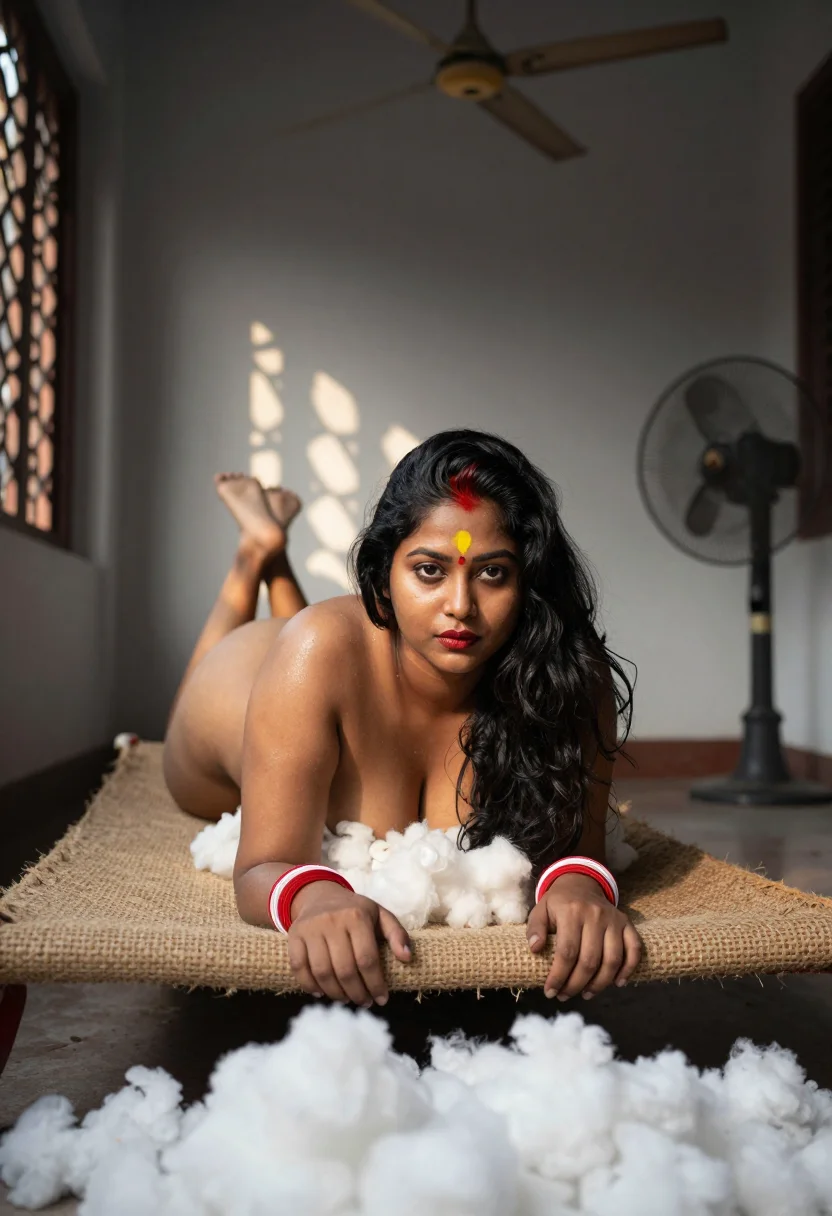
The saree carries the sequence rather than a set change: red-bordered white cotton with the pallu drawn over the shoulder, then draped loose at the cot's edge, then arranged around her as she lies back, the sindoor and the shankha bangles constant throughout. Each frame is a settled state the heat has already arrived at.
Photographically the light is hard and specific: lattice-thrown diamonds on the wall in the standing frame, the same pattern softened across the collarbones once she is seated, and full afternoon sun on hip and shoulder in the reclining frame. All nine images are photographic in construction and AI-generated in execution — no real person was photographed to produce any of them.
Frequently asked questions
- What is in the Bengali Boudi Muse pack?
- Nine frames in a Kolkata para house between the morning market and the evening return. Three on the veranda in the white cotton saree with its red border, the pallu drawn over the shoulder, sindoor in the parting and a shankha bangle on each wrist. Three seated at the cot's edge in the lattice light, the pallu over one arm. Three reclining on the cot with a palm-leaf fan, the pleats arranged around her, the bangles and sindoor in place, the ceiling fan still overhead. Three frames per stage, one payment for the set.
- Are these real photographs or AI-generated?
- AI-generated, built on photographic principles — light, shadow edge and skin texture rendered the way a camera would record them, not drawn and not animated. The bengali boudi register here reads as a photograph because every frame is composed from the first pixel forward against a written brief, not lifted from an existing image.
- What does the boudi wear across the set?
- A red-bordered white cotton saree with a matching blouse, worn first with the pallu drawn over the shoulder; then draped loose at the cot's edge; then arranged around her as she lies back on the cot, with the sindoor in the parting and a red-and-white shankha bangle on each wrist, held constant through all nine frames.
- Why does the house feel empty?
- Because the register is deliberate: the boudi has the house to herself between the morning market and the evening return, and the heat of a load-shedding afternoon is reason enough to lie down on the cot. The fan is still, the lane outside is quiet, and nothing in the nine frames suggests anyone else is home.
- How is this different from the Agraharam Courtyard pack?
- Agraharam Courtyard is the ritual register — a Chennai courtyard, a thali chain and jasmine plait. This pack is the domestic register instead: a Kolkata veranda in the afternoon heat, a red-bordered saree and a cot in the lattice light. Same desi-wife archetype, different house and different hour.
- Do I need to upload a selfie?
- It is optional. One clear front-facing photo casts the muse in your likeness across all nine frames; skip it and the house casts its own. Your selfie steers the face — it is never an image being altered.
- Where does the light come from?
- Hard afternoon sun through a lattice screen: diamonds on the plaster wall in the veranda frames, softened across the shoulders once she is seated, full sun on the cot in the reclining frames. One house, one afternoon, nine frames delivered whole for one payment.
- Can I use the frames once unlocked?
- Personal and creative use. Not for commercial redistribution, not to present as a real person's photograph, and not for use against any individual.
- Is there an age requirement?
- Access requires confirming you are 18 or over. The muse is an adult woman composed from a written brief rather than photographed, so she is not a real person; if you cast your own face into the set, that likeness is yours and yours only.
- Who is in the photos?
- A muse you choose. 32 AI faces, none of them a real person.
Who Reaches for the Bengali Boudi Register
- People searching bengali boudi photos who want the domestic-heat register rather than a studio set
- Photographers studying how a lattice screen throws diamond light across skin at three different distances
- Writers and worldbuilders who need one consistent boudi archetype across a coherent nine-frame afternoon
- Anyone building a desi boudi moodboard that has to hold one grade of light across a single location
- Fans of the bengali bhabhi register looking for a photographic rather than illustrated take
- Collage artists who need a red-and-white saree palette against warm plaster and cot rope
- Adults curious about the South Asian domestic register of AI photography at an accessible entry price
About Ovid
Ovid is a house of pictures that were never taken. Most AI image tools ship one giant catalog of poses and aesthetics; the output looks like every other generated image on the internet. Ovid goes the other way. Each pack is a single editorial brief — light, styling, scene composed in the grammar of the great fashion editorials — hand-curated against real references and tested before it ships. Free preview before you pay. Packs are one-time. No template generator, no feed. A fashion house, not a catalog.