/bosphorus-yali
Bosphorus Yali Muse — Nine AI Photos
Make it with your museBosphorus Yali Muse — Nine AI Photos
Open this world on the wall, and make it with your muse.
all 9 frames of her, in this world ↓
The Yali Register: Blue Water, Carved Wood, One Marble Room
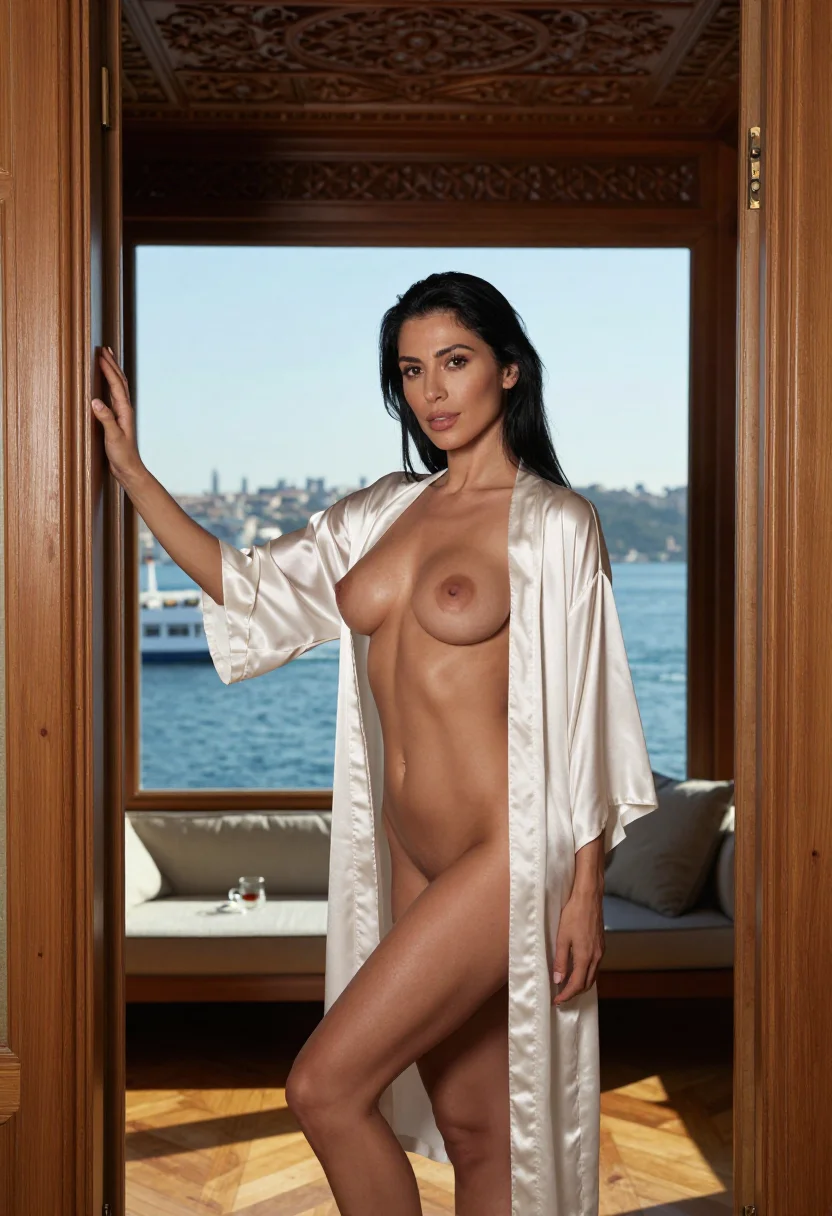
The yali is architectural before it is anything else. A yali turns its back on the road and gives its whole front to the Bosphorus, so the water side of the house has no neighbour at all — only the strait, the ferries a long way out, and the far shore's hills going blue with distance. This pack lives on that side: a tall window with a tea glass on the sill and a carved wooden ceiling above the divans, a boat-house landing where the boards stay wet, and a small hamam room with a fountain basin that the household built for itself. Nothing needs a pretext here. The building already is one.
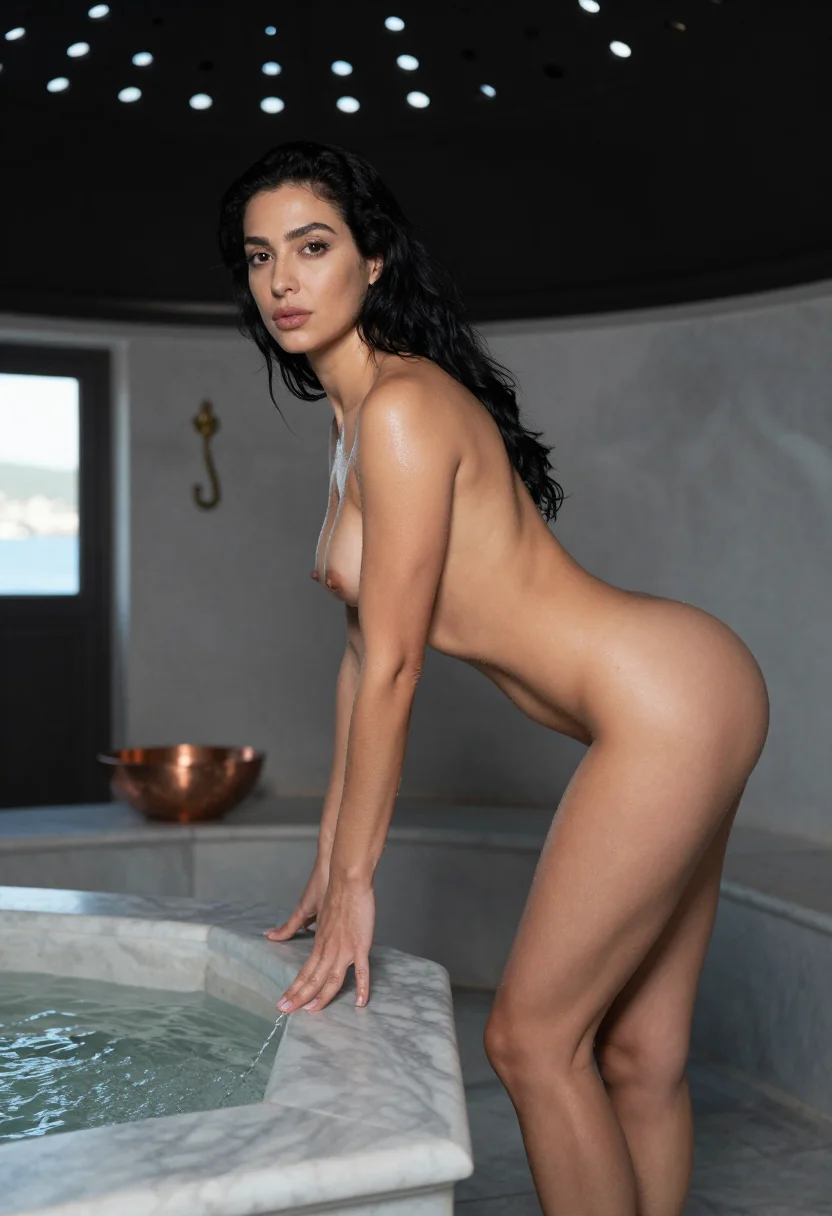
Three lighting conditions carry the nine frames. The window frames are broad and cool: an entire pane of morning sea-light, near and large, laying a gradual shadow edge under the jaw while the water throws a second dimmer wash up onto the underside of her arms; the parquet holds the only warmth in the frame. The landing is the hardest of the three — open sun on wet wood, speculars firing off the water on her calves and shoulders, a moored boat rocking and the mid-strait ferries reduced to white blurs. The hamam is the softest: narrow shafts dropping from the dome's light-holes through standing steam onto white marble, the copper bowl on the floor picking up the one warm reflection in the room.
The mood moves one step per setting. The silk kaftan is belted at the window, one hand on the frame and the other holding its edge at her hip; on the landing she is seated on the edge with the hem lifted clear and her feet in the cold green-blue, both palms flat on the wet wood; in the hamam she is on the marble bench with one hand on the basin's lip. The pose craft holds throughout — hands find frame, edge, boards, marble lip or bench, knees turn, and no limb is pointed at the lens in any of the nine.
All nine frames are photographic in construction and AI-generated in execution: specular highlight on wet wood and wet skin, the soft shadow edge of a window-sized source, silk, steam and old marble rendered from photographic principles rather than drawn or painted. The Bosphorus set sits closer to fine-art portraiture than to glamour — it is a room and a light before it is a figure. The strait is borrowed for its geometry; nothing in the set documents a real house or a real photograph.
Frequently asked questions
- What is in the Bosphorus Yali Muse pack?
- Nine frames in a waterside mansion on the Bosphorus, across three rooms of it. At the tall window: a long silk kaftan belted at the waist, one hand on the window's frame and the other holding the silk's edge at her thigh, the strait filling the glass with blue and a ferry's white passing, a tea glass on the sill. On the boat-house landing: seated at the edge with the hem lifted clear, her feet in the green-blue water and both hands flat on the wet wood beside her hips, a boat rocking on its line. In the hamam: on the marble bench with the fountain's basin running beside her, the copper bowl on the floor, the dome's light-holes overhead. Three frames per setting, one payment for the set.
- Are these real photographs or AI-generated?
- AI-generated, built on photographic principles. A whole window of sea daylight is a broad near source — soft-edged shadow under the jaw, with a second dimmer wash bouncing up off the water onto the underside of the arms. The landing is open sun on wet wood, hard and specular, the strait behind it thrown out of focus. The hamam is the softest light in the pack: a dome pierced with small holes drops narrow shafts through steam onto white marble. Silk, wet skin, old parquet and marble each answer that light differently. It reads as a photograph made in a house on the water, not as an illustration of one.
- What is a yali, and why this setting?
- A yali is a wooden waterside mansion on the shores of the Bosphorus, built with its back to the road and its whole front to the strait. That geometry is the pack's whole premise: the water side has no neighbour and no street, the ferries are half a kilometre out and moving, and the hamam room was built for the household rather than for guests. Nothing has to be justified here — the house was made for exactly this kind of privacy.
- What is she wearing across the nine frames?
- A long silk kaftan, belted at the waist, from the first frame to the last — at the window, on the boat-house boards with the hem lifted clear of the water, and in the hamam with steam on the silk. Each frame is a settled state rather than a step in a sequence — nothing is ever caught in motion between two of them.
- How is this different from a hammam or Turkish bath pack?
- A public bath is the Turkish bath at civic scale — a big hot room, many niches, an audience implied even when the frame is empty. The hamam here is domestic instead: one household's own room off a wooden house, a small marble bench, a single fountain basin, a copper bowl, one small window with the Bosphorus's light in it. Same marble vocabulary, private scale, and the two settings before it are outdoors on the water.
- Why does the light change across the three settings?
- Because the house does. The window frames are broad and cool — a full pane of sea daylight, morning, with the parquet warm underneath and a soft bounce coming back up off the strait. The landing is the hardest light in the pack: direct sun on wet boards and silk, gulls and ferries blurred behind. The hamam inverts both, dome-light through steam onto white marble, the softest and the quietest of the three.
- Is the Bosphorus setting historically accurate?
- Period-shaped rather than documentary. The carved wooden ceiling, the divans, the tea glass on the sill, the boat-house landing and the small domestic hamam are drawn from the yali as a building type and from photographs of the Bosphorus shore. The pack borrows that register for its light and its objects; it does not claim to document a particular house, or anyone who lived in one.
- Do I need to upload a selfie?
- It is optional. One clear front-facing photo casts the muse in your likeness across all nine frames; skip it and the house casts its own. Your selfie steers the face only — it is never the image being worked on.
- What does the house look like?
- A carved-wood waterside mansion: a tall window over the strait, divans under a carved ceiling, a boat-house landing, a small domestic hamam. One house, three rooms, three lighting conditions — delivered whole for one payment.
- Can I use the frames once unlocked?
- Personal and creative use. Not for commercial redistribution, not to present as a real person's photograph, and not for use against any individual.
- Is there an age requirement?
- Access requires confirming you are 18 or over. The muse is an adult woman composed from a written brief rather than photographed, so she is not a real person; if you cast your own face into the set, that likeness is yours and yours alone.
- Who is in the photos?
- A muse you choose. 32 AI faces, none of them a real person.
Who Reaches for the Yali Register
- People searching yali or Istanbul photos who want water and wood rather than a studio
- Anyone building a waterside mansion set that has to hold one house and one grade across nine images
- Photographers studying what a window-sized source plus a bounce off open water does to skin
- Architecture and interiors people looking at carved wood, parquet and a small domestic hamam as a light problem
- Writers and worldbuilders who need one consistent character through one morning in one building
- Collage and moodboard makers who need photographic-quality Bosphorus material rather than stock travel imagery
- Adults curious about the Mediterranean-and-marble register of AI photography
About Ovid
Ovid is a house of pictures that were never taken. Most AI image tools ship one giant catalog of poses and aesthetics; the output looks like every other generated image on the internet. Ovid goes the other way. Each pack is a single editorial brief — light, styling, scene composed in the grammar of the great fashion editorials — hand-curated against real references and tested before it ships. Free preview before you pay. Packs are one-time. No template generator, no feed. A fashion house, not a catalog.