/calendar-girl
Calendar Girl Muse — Nine AI Photos
Make it with your museCalendar Girl Muse — Nine AI Photos
Open this world on the wall, and make it with your muse.
all 9 frames of her, in this world ↓
The Calendar Register: Chrome, Tungsten, and the Twelfth Page
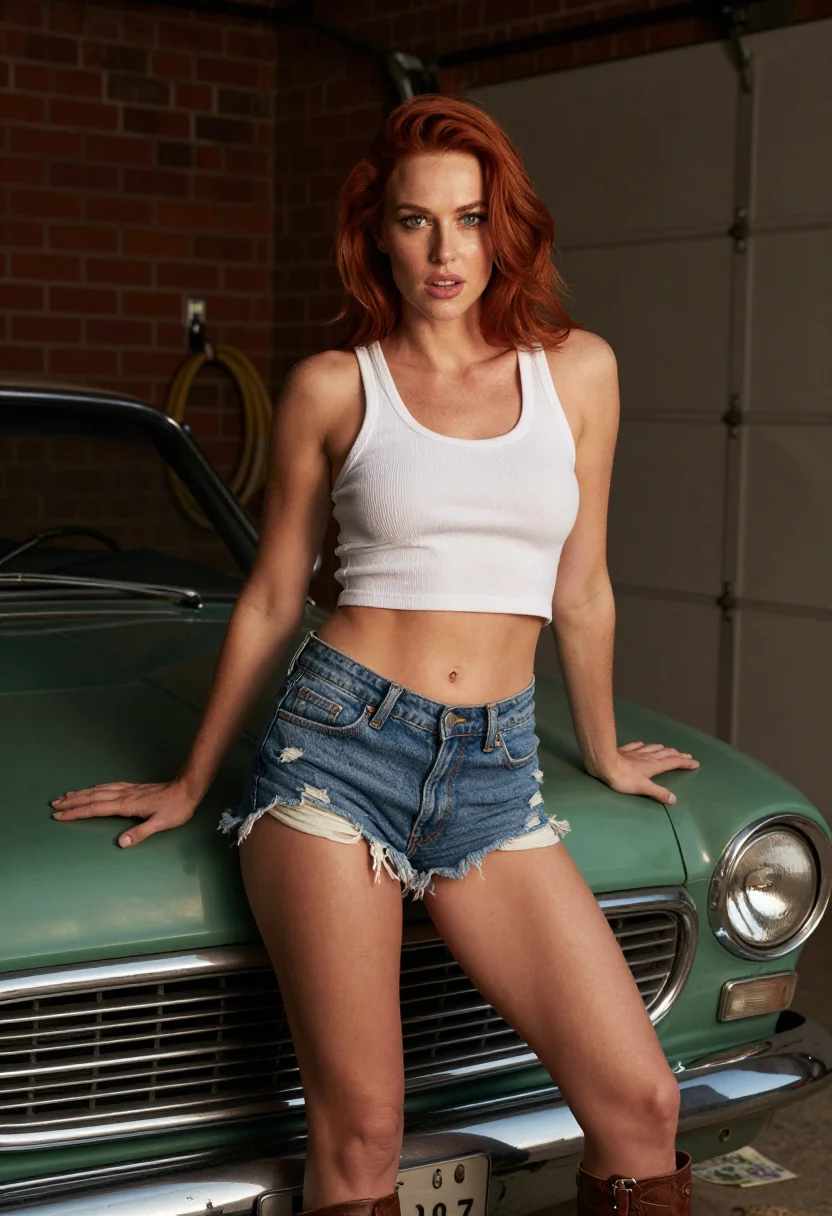
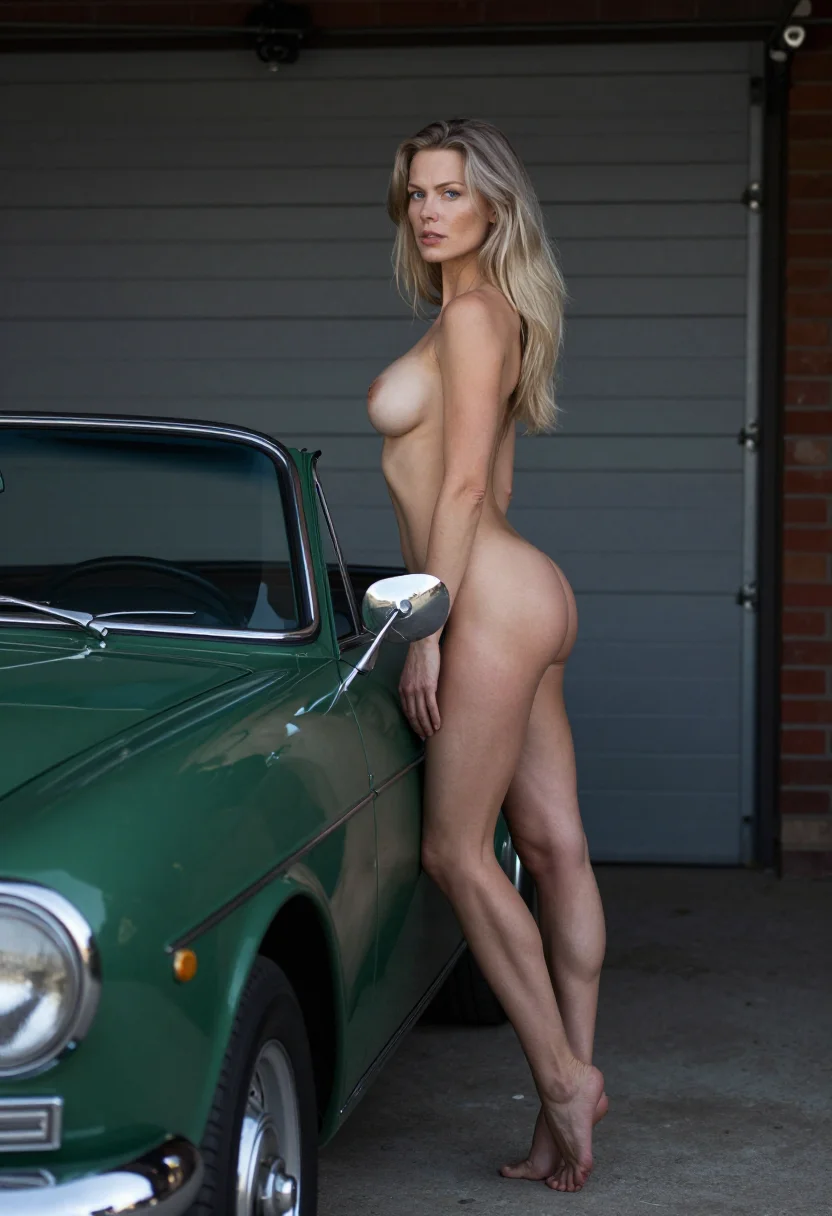
A calendar is twelve pages and one promise, and this pack shoots the last one. The room is a working garage — brick, a rolled hose, a garage door with slats, number cards lying blurred on the floor — and the only piece of furniture is an old convertible with a chrome grille and paint deep enough to hold a reflection. She arrives in a cropped tank, denim shorts, boots, hair set in a wave, and by the ninth frame she is lying across the car's warm paint.
Three stages, each photographed at rest. At the grille she stands with one hand on the fender and one boot on the running board, the chrome throwing her back at her in curves. On the fender she is seated, one heel on the bumper, both hands on cold chrome either side of her hips, the headlamp's glass at her knee. On the bonnet she lies at three-quarters framed from the head end, one arm along the chrome trim, one knee raised, the windscreen frame at her shoulder.
The light is the whole argument. Two tungsten lamps stand warm at either side and lay long gradients down her shoulders and along the paint; the chrome answers with hard specular curves that read almost as drawing. Then in the last third a flash fires from the front-quarter and freezes the highlights outright — cold in front, warm behind, the shadows suddenly crisp. Chrome and flash is a difficult pairing to shoot and the reason the pin-up calendar looks the way it does.
The calendar girl search ends here honestly, and so does the wider pin-up calendar and ai pin-up register: nothing in these nine frames was lifted off a real photograph of a real garage. Each is written before it is rendered — the car, the lamps, the flash, the pose — and composed from the first pixel forward. All nine are photographic in construction and AI-generated in execution; no real person was photographed to produce any of them, and the car carries no badge, plate or maker's mark of any kind.
Frequently asked questions
- What's in the Calendar Girl Muse pack?
- Nine frames in one garage around one old convertible. Three in a cropped tank and denim shorts beside the chrome grille, one hand on the fender and one boot on the running board, hair set in a wave. Three seated on the fender, one heel on the bumper, both hands on the chrome either side of her hips. Three across the bonnet, lying at three-quarters from the head end with one arm along the chrome trim and one knee raised. Three frames per stage, one payment for the set.
- Does this work from an existing photo of someone?
- No. Nothing is generated by altering an existing image, because no existing image is read. Each frame is written first — the car, the lamps, the flash, the pose, the number card on the floor — and composed by the model from the first pixel forward.
- Are these real photographs or AI-generated?
- AI-generated, built on photographic principles. Two tungsten lamps sit warm at either side and throw long soft gradients along her shoulders; the chrome answers them with hard, curved speculars that return her own shape back at her. In the last third a flash fires from the front-quarter and freezes everything — cold in front, warm behind, the paint deep and reflective under her. It reads as a calendar photograph, not as an illustration.
- What are the three stages?
- Grille — cropped tank and denim shorts, standing at the chrome with brick and a rolled hose behind. Fender — seated on the chrome, the headlamp's glass at her knee and the garage door's slats behind. Bonnet — across the paint at three-quarters, the flash cold from the front-quarter, the windscreen's chrome frame at her shoulder.
- What's the wardrobe?
- A cropped tank, denim shorts, boots, and hair set in a hard wave — the whole hot rod pin-up kit, worn unchanged from the first frame to the last. No jewellery, no styling changes between stages.
- Is there a real car brand or badge in the frames?
- No. The convertible is a period shape — chrome grille, chrome trim, deep reflective paint, a bright headlamp bezel — with no badges, no plates and no maker's mark anywhere on it. The number cards on the floor stay blurred and carry no legible digits. Nothing in the garage identifies a marque, a shop or a year.
- How is this different from a studio portrait pack?
- A studio set is soft, close and interior. This is a garage calendar: brick, a rolled hose, cold chrome under warm lamps, and a flash that cuts rather than wraps. The convertible chrome register is graphic and hard-edged by construction — reflections doing half the composing — where studio portraiture asks light to be kind.
- What does the garage look like?
- A working garage: brick, a rolled hose, a slatted door, number cards blurred on the floor, and one old convertible with chrome and deep paint. One car, three stages, chrome and flash throughout — delivered whole for one payment.
- Do I need to upload a selfie?
- It's optional. One clear front-facing photo casts the muse in your likeness across all nine frames; skip it and the house casts its own. Your selfie steers the face — it is never a photo that gets altered.
- Can I use the frames once unlocked?
- Personal and creative use. Not for commercial redistribution, not to present as a real person's photograph, and not for use against any individual.
- Is there an age requirement?
- Access requires confirming you are 18 or over. The muse is composed from a written brief rather than photographed, so she is not a real person; if you cast your own face into the set, that likeness is yours and yours only.
- Who is in the photos?
- A muse you choose. 32 AI faces, none of them a real person.
Who Reaches for the Calendar Register
- People searching calendar girl photos who want the garage and the car, not a studio backdrop
- Photographers studying how warm tungsten and a cold front-quarter flash fight each other across chrome and skin
- Artists working from reflections — how a curved chrome grille and deep paint return a figure back into the frame
- Writers and worldbuilders who need one consistent character across a single shoot with a hard visual grammar
- Anyone building a hot rod pin-up moodboard that has to hold one grade across nine images
- Collage artists who need photographic-quality car bonnet material rather than soft studio glamour
- Adults curious about the vintage pin-up register of AI photography
About Ovid
Ovid is a house of pictures that were never taken. Most AI image tools ship one giant catalog of poses and aesthetics; the output looks like every other generated image on the internet. Ovid goes the other way. Each pack is a single editorial brief — light, styling, scene composed in the grammar of the great fashion editorials — hand-curated against real references and tested before it ships. Free preview before you pay. Packs are one-time. No template generator, no feed. A fashion house, not a catalog.