/carhop
Carhop Muse — Nine AI Photos
Make it with your museCarhop Muse — Nine AI Photos
Open this world on the wall, and make it with your muse.
all 9 frames of her, in this world ↓
The Carhop Register: Mint Poplin, Chrome and a Sign That Never Stops Burning
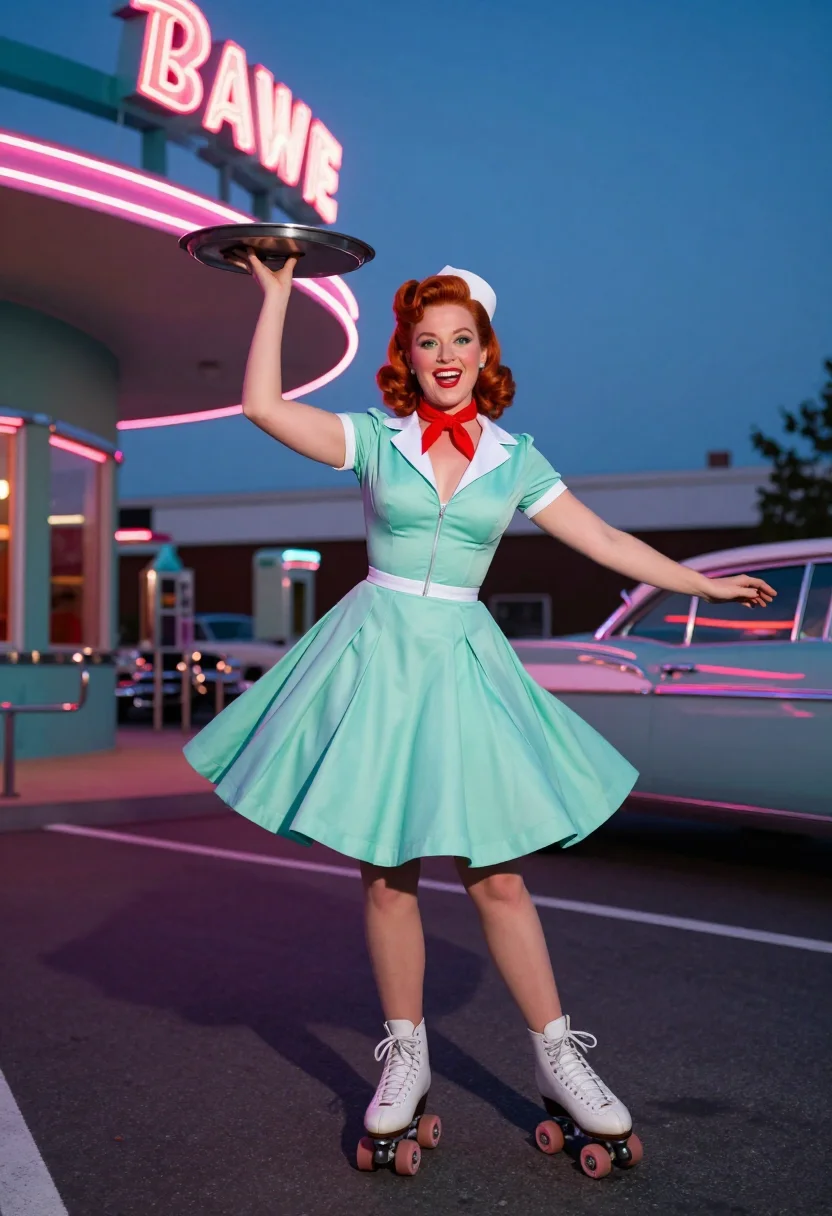
The American calendar pin-up gave the twentieth century one of its most durable poses, and the drive-in carhop gave that pose a job. Elvgren and Vargas painted her leaning, reaching, carrying, always caught mid-gesture; this pack takes the same body language and shoots it as period photography rather than pastiche. The carhop dress is treated as a real garment — mint-green cotton poplin, white piping, a notched collar, a full-length front zip, a full skirt cut to swing — and everything the frame does depends on how that skirt moves. Seamed stockings, a red neckerchief and white leather skates laced in red finish it. This is a 50s pin up series and a pin up photoshoot in the literal sense: the poses come from the work, not from a studio mark.
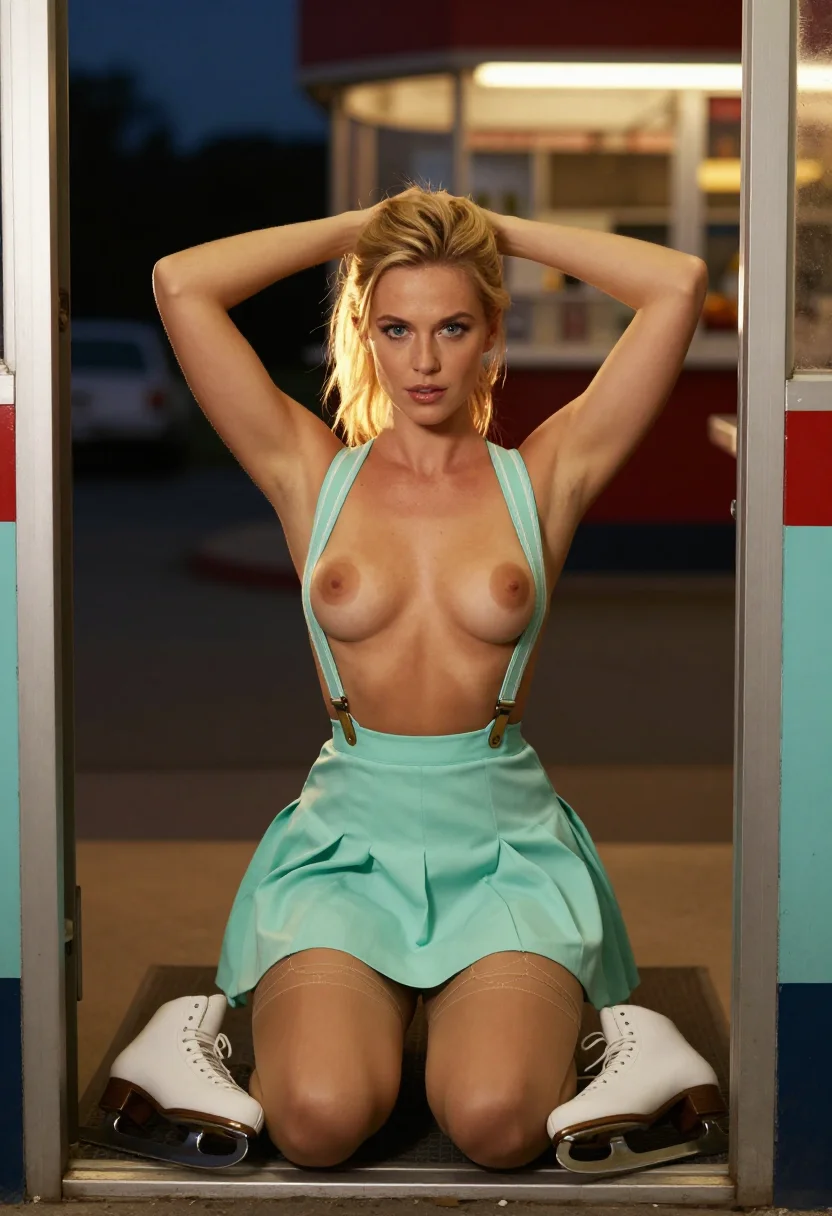
One evening carries the sequence in three movements. It opens in the dusk lot with the neon sign burning overhead — a small saturated source that lands magenta on a turned shoulder and cyan in the eyes, drops the asphalt to near-black, and bends into a stretched reflection along a chrome fender. It moves carside into low late-afternoon sun, small and far and therefore hard, raking across a bonnet of cream lacquer with warm bounce lifting the shadow side. It closes in the diner doorway with the skates knotted over one shoulder and the interior glowing broad and near from behind, wrapping the figure while the cool night lot fills weakly from the front. Motion runs through all three: a skate carving an edge into a turn, a body folded into a rolled-down window, a knee turned in against a painted jamb.
Every frame in this pack is composed for the carhop register from the ground up — the dress is written in the brief before a pixel exists, and the muse wearing it is generated for this world, not a real photograph and not a real person.
The house casts a range of muses across the nine frames — a rose-ivory redhead with copper waves pinned in rolls, a golden-beige blonde in a high ponytail, a deep-umber brunette in victory rolls — so the carhop is a look rather than a single body. Every frame is AI-generated and photographic in finish: the neon shadow edge, the specular riding a collarbone, the catchlight in each eye are rendered from photographic principles, not drawn or animated.
Frequently asked questions
- Who is the muse? Is this a real carhop?
- No. The muse is an AI creation, generated for this pack — a fictional figure with no photograph as input and no real-world referent.
- What is in the Carhop Muse pack?
- Nine frames of a 1950s carhop across three parts of one evening: the dusk parking lot under a burning neon sign, the customer's cream-lacquer car in low late sun, and the diner doorway at closing time with the skates slung over a shoulder by their laces. One mint-green poplin carhop dress with white piping, a red neckerchief and white roller skates carry the register across all nine. Three frames per setting.
- Are these real photographs or AI-generated?
- AI-generated, and photographic in finish. The hard magenta edge where neon strikes a collarbone, the crisp shadow the low late sun draws along a thigh, the warm bloom of the diner interior behind a shoulder — all rendered from photographic principles, so the result reads as a period photograph, not an illustration and not an anime render.
- Why does the light change so much between the frames?
- Because the pack follows one evening rather than one lamp. A neon sign is a small saturated source that cuts a hard magenta-and-cyan edge and lets the asphalt fall to near-black. Low late sun is also small and far, so it draws a crisp edge, but warm and open with bounce off cream car paint. The diner doorway is a broad near source from behind, which wraps the body and puts a bright line along the hair. Three hours, three logics, one shoot.
- Why the same dress in every frame?
- Because the dress is the register. The pack was engineered around one wardrobe — a mint-green poplin carhop dress with white piping and a notched collar, a red neckerchief, white leather skates laced in red, seamed stockings and a suspender belt — so the nine frames read as a single shift rather than nine unrelated images. What changes is the light, the setting and the pose.
- How is this different from the other retro-workplace packs?
- Carhop is outdoors and in motion: skates, a steel tray, neon and gold hour, a dress with a front zip. Last Call is the bar after the door locks — black poplin, a loosened tie, cold backbar light. Garage Jumpsuit is the shop floor in navy twill under a drop-light. Secretary Desk is the mid-century office in hard slatted daylight. Same era in places, different work, different light.
- What does the evening look like?
- One 1950s evening in three parts: the dusk parking lot under a burning neon sign, the customer's cream-lacquer car in low late sun, and the diner doorway at closing time. One wardrobe, three lighting logics, delivered as a single purchase.
- Can I use the frames once unlocked?
- Personal and creative use. Not for commercial redistribution, not to present as a real person's photograph, and not for use against any individual.
- Is there an age requirement, and is a real person depicted?
- Access requires confirmation of age (18+). No real person is named, depicted or impersonated anywhere in this pack; every muse is AI-generated.
- Who is in the photos?
- A muse you choose. 32 AI faces, none of them a real person.
Who Reaches for the Carhop Register
- Anyone searching carhop, roller skate girl or vintage diner photos who wants the register shot properly — mint poplin, skates, tray — as a composed AI photoshoot rather than a single lucky prompt
- People drawn to 1950s Americana and the calendar pin-up tradition who want it photographic instead of painted or illustrated
- Photographers and lighting students studying how a small saturated neon source behaves on skin against a near-black surround
- Artists researching mid-century diner and drive-in material culture: carhop uniforms, chrome fenders, cream lacquer, steel trays
- Writers and screenwriters working in a 1950s American setting who need a consistent face for a fictional character across scenes
- Adults curious about AI pin-up photography at an accessible entry price
About Ovid
Ovid is a house of pictures that were never taken. Most AI image tools ship one giant catalog of poses and aesthetics; the output looks like every other generated image on the internet. Ovid goes the other way. Each pack is a single editorial brief — light, styling, scene composed in the grammar of the great fashion editorials — hand-curated against real references and tested before it ships. Free preview before you pay. Packs are one-time. No template generator, no feed. A fashion house, not a catalog.