/cinema-flash
Cinema Muse — Nine AI Photos

Make it with your museCinema Muse — Nine AI Photos
Open this world on the wall, and make it with your muse.
all 9 frames of her, in this world ↓
The Cinema Register: the Room as the Stage
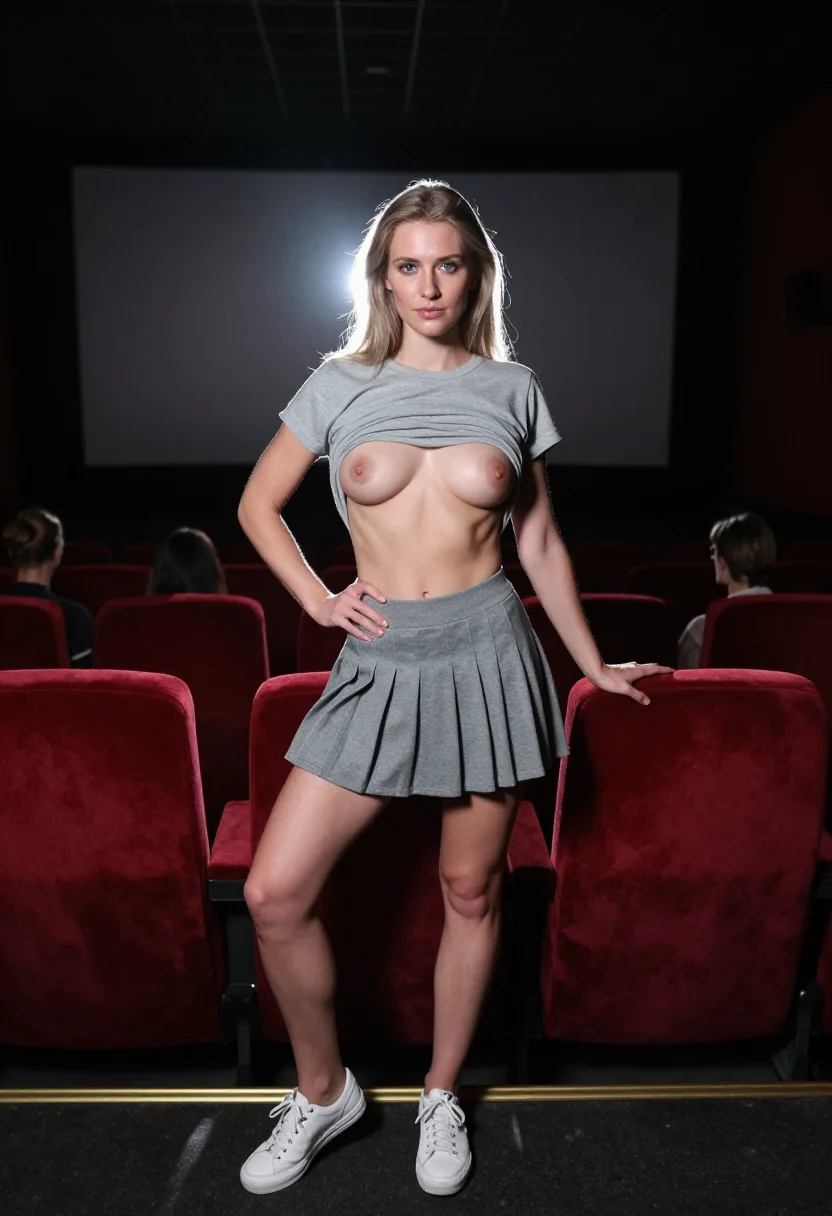
This is the auditorium itself as the stage — the rows of seats read as much as any street or bedroom, and the projector beam is the key light. The screening is running, the room sparsely occupied, and the sequence moves from a t-shirt knotted high and a skirt to a muse with her shoes off and her feet up among the seats. Exactly one face appears in any frame — hers, turned to the lens — while every other patron is a dark shape cropped or absorbed by the screen, never reacting.
The projector cone carries most of the light: a cool, slightly diffuse white beam with visible dust motes and a hard edge into the surrounding dark, occasionally cut through by a shifting colored wash off the screen itself. Red-velvet seat backs recede in soft perspective behind her in every frame, and aisle-step floor lights add small warm points low in the frame.
Every frame is written first — the room, the beam, the pose — and composed from the first pixel forward. All nine are photographic in construction and AI-generated in execution; no cinema chain, film title, or studio branding appears anywhere, and the screen itself shows abstract light only.
A projector beam portrait and auditorium photoshoot, built from a skirt-and-tee cinema sequence across red velvet seats.
Frequently asked questions
- What is in the Cinema Muse pack?
- Nine frames set inside a sparsely occupied cinema screening: three mid-row in a t-shirt knotted high and a pleated skirt under the projector cone, three kneeling on a seat turned back toward the lens in the screen flicker, three standing full-length in the row with a jacket over one arm. Three frames per setup, one payment for the set.
- Who is the muse? Is she a real person?
- She is an AI muse — generated for this pack, entirely synthetic and fictional, with no photograph as input and no real-world referent. Each frame is written first, the auditorium and the pose, and composed from the first pixel forward.
- Are these real photographs or AI-generated?
- AI-generated, built on photographic principles. The projector beam throws a cool white cone with visible dust motes and a hard falloff into the dark rows; screen flicker adds a shifting, colored bounce across skin. It reads as a phone photograph shot in a dark room, not an illustration.
- Are there other people in the frame? Do they react?
- Other patrons appear only as dark, unidentifiable shapes — cropped at the shoulders or absorbed by the screen, never turned toward her, never reacting. Hers is the only face in any frame; every other figure in the set is an adult.
- Is this real film footage or a real theater?
- No. The screen shows abstract light only — no film title, no studio logo — and no cinema chain or real venue is named or depicted anywhere in the set. The room is generic by design.
- Which garments are in it?
- A plain t-shirt knotted high and a short pleated skirt, worn from the first frame to the last. What changes is the pose: mid-row, kneeling on a seat, standing in the row with a jacket over one arm.
- Is there an age requirement?
- Access requires confirming you are 18 or over. The muse is composed from a written brief rather than photographed, so she is not a real person.
- Who is in the photos?
- A muse you choose. 32 AI faces, none of them a real person.
Who Reaches for the Cinema Register
- People searching cinema photoshoot or movie theater portraits who want the auditorium's own point of view
- Photographers studying how a projector cone and dust motes carry light across a dark room
- Writers and worldbuilders who need one consistent character across a night-at-the-movies set piece
- Anyone building a movie theater moodboard that has to hold one grade across nine images
- Collage artists who need photographic-quality dark-auditorium material rather than studio glamour
- People comparing public-setting AI packs who want the bystander rule handled correctly — one face, no reactions
- Adults curious about the cinema register of AI photography at an accessible entry price
About Ovid
Ovid is a house of pictures that were never taken. Most AI image tools ship one giant catalog of poses and aesthetics; the output looks like every other generated image on the internet. Ovid goes the other way. Each pack is a single editorial brief — light, styling, scene composed in the grammar of the great fashion editorials — hand-curated against real references and tested before it ships. Free preview before you pay. Packs are one-time. No template generator, no feed. A fashion house, not a catalog.