/cyborg-alley
Cyborg Girl Muse — Nine AI Photos
Make it with your museCyborg Girl Muse — Nine AI Photos
Open this world on the wall, and make it with your muse.
all 9 frames of her, in this world ↓
The Neon-Street Register: Chrome Arm, Rain, a Quiet Rooftop
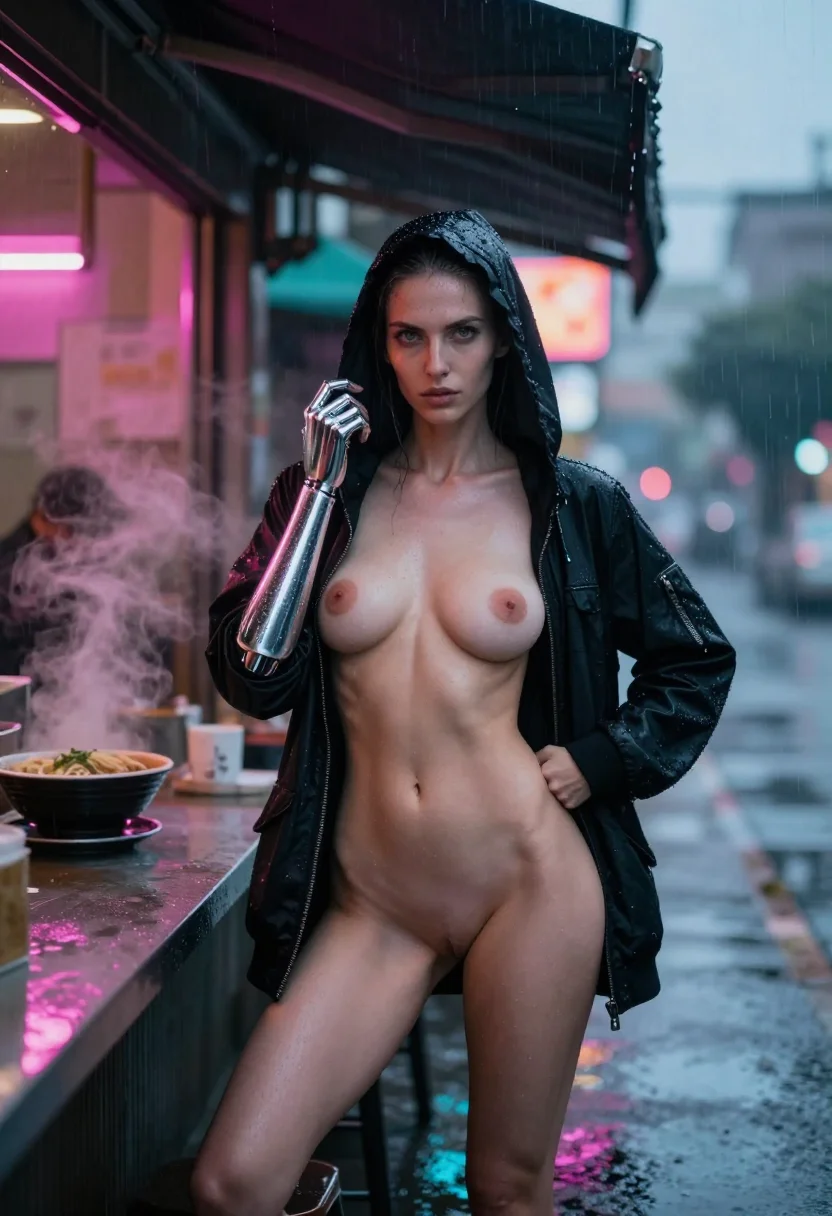
The city is the whole pack. Rain, a ramen counter throwing steam across the light, an awning's edge, a wet railing, a concrete stairwell off the alley, and above all of it a rooftop where the signs still reach but nobody does. She moves through it with one full chrome arm from shoulder to fingertips and a hooded jacket worn open over a black tank — which is the register in one image: she simply dresses this way in her own city, and the camera is available-light street photography keeping up with her.
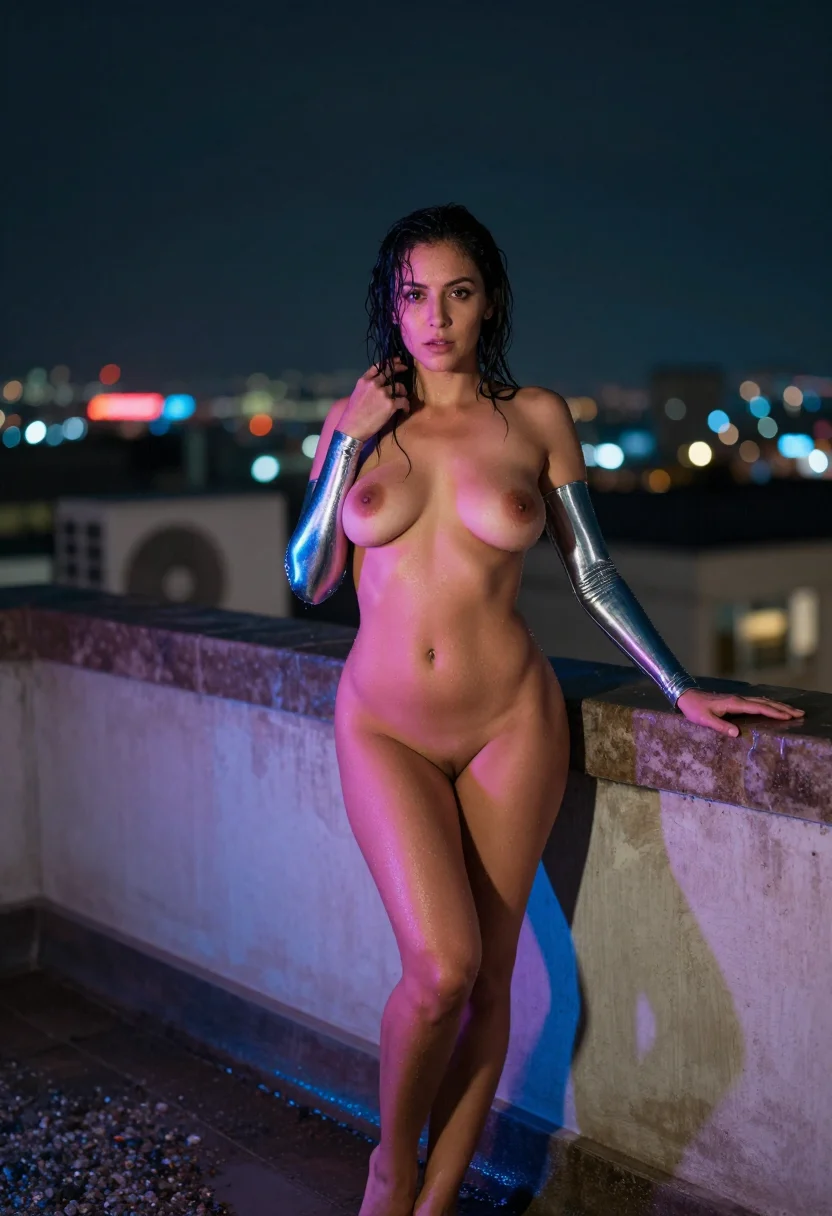
Three places run the set, and each changes one layer. Under the awning: jacket open over the tank, chrome hand on the wet railing, the other holding the hood back, magenta and cyan reflected in the puddles and the neon rain beading the metal. In the stairwell: jacket slung over the rail, the chrome arm's forearm panel open on wiring under a small service light, a data-jack visible behind her ear, seated on a step with the arm resting on her knee. On the rooftop parapet: seated on its inner ledge in the tank, the panel sealed again, the chrome arm along the parapet's top and one leg drawn up. The metal opens and closes while the rest of her stays put — that sequence is the pack's argument.
The mechanical vocabulary is rationed to three nouns — chrome arm, forearm panel, data-jack — and nothing else on her is hardware. The arm reads as a limb she has had for years rather than as a device being demonstrated; the panel is a catch, not a cutaway; the jack is a detail behind the ear you notice second. Between them the skin renders as skin under coloured light, which is the hardest thing in the pack to get right and the reason the palette stays disciplined.
Three light regimes, all of them found: bounced sign colour off wet street, directionless and saturated, with rain making hard speculars on chrome; then steep sodium light from a landing above onto wet concrete, with the alley's neon a single stripe through the doorway; then the rooftop's ambient wash from the signs below, pink and blue, with no hard source anywhere. No sign in any frame carries legible text. All nine frames are photographic in construction and AI-generated in execution — specular on wet metal, shadow edge, skin and denim rendered from photographic principles, not drawn and not animated. No real person was photographed to make any of them.
Frequently asked questions
- What is in the Cyborg Girl Muse pack?
- Nine frames across one wet night, in three places. Three in the neon rain outside a ramen counter, one full chrome arm from shoulder to fingertips, a hooded jacket worn open over a black tank, the chrome hand on a wet railing and the other holding the hood back. Three in a concrete stairwell with the jacket slung over the rail, the chrome arm's forearm panel open on wiring under a small service light, a data-jack visible behind her ear. Three on the rooftop parapet with the panel sealed again and the city's signs washing across her. Three frames per place, one payment for the set.
- Are these real photographs or AI-generated?
- AI-generated, built on photographic principles. Three light regimes carry it: magenta and cyan signage bounced back off wet street and puddles, coloured and directionless, with rain beading hard speculars on the chrome; then sodium light falling from a landing above onto wet concrete, warm and steep, with the alley's neon a single stripe through the doorway; then the rooftop's soft ambient wash from signs below, pink and blue, no hard source at all. It reads as available-light street photography at night, not as an illustration.
- How much of her is mechanical?
- Rationed to three things: one full chrome arm from shoulder to fingertips, the forearm panel that opens on it, and a data-jack behind her ear. Nothing else. The rest is an adult woman walking through her own city — the chrome arm reads as a limb she has had for years, not as a prosthetic on display.
- What is she wearing, place by place?
- A hooded jacket worn open over a black tank and jeans in the rain, the hood held back with her other hand. Then the jacket slung over the stairwell rail while the forearm panel is open. Then the tank and jeans on the rooftop, seated on the parapet's inner ledge with the chrome arm along its top and one leg drawn up. Each stage is a settled state, never a half-motion.
- Why does the forearm panel open?
- Because on this body it is the second garment. The jacket goes over the stairwell rail and the panel opens in the same beat, showing wiring under a small service light — and by the rooftop it is sealed again. That sequence is the pack's whole idea: the metal opens for a moment, then closes.
- Is there any readable text on the signs?
- None anywhere in the nine frames. The city's signage is colour and glow only — magenta, cyan, pink and blue on wet surfaces, no shop name, no slogan, no legible character. It keeps the images from becoming a photograph of somebody else's street rather than of her.
- How is this different from the Repair Shop pack?
- Repair Shop is the back room off this street — one bench, one warm lamp, neon only as stripes through a shutter, and a body opened at the back and knee for work someone else is doing. This one is outdoors and mobile: rain, a ramen counter, a stairwell, a rooftop, and a panel she opens herself. Same city, opposite side of the door.
- How is this different from the Combat Unit pack?
- Combat Unit is a military gynoid after a field, with damage she did not choose and armour stacked on a transport ramp. This is a civilian with one chrome arm and a jacket, in weather rather than in a war. The metal there is cracked open by force; here it opens on a catch, by her own hand.
- Where does the last third actually take place?
- A rooftop under the neon glow, once the rain has slackened: seated on the rooftop parapet's inner ledge, the chrome arm resting along its top, one leg drawn up, an aircon unit humming at the frame's edge and wet gravel underfoot. It is the quietest light in the pack and the only place in it where nobody could walk past.
- What does the night look like?
- One wet night in a neon city: a ramen counter's awning, a concrete stairwell off the alley, a rooftop under washing signs. Three locations, three lighting logics — delivered whole for one payment.
- Can I use the frames once unlocked?
- Personal and creative use. Not for commercial redistribution, not to present as a real person's photograph, and not for use against any individual.
- Is there an age requirement?
- Access requires confirming you are 18 or over. The muse is an adult woman composed from a written brief rather than photographed, so she is not a real person; if you cast your own face into the set, that likeness is yours and yours only.
- Who is in the photos?
- A muse you choose. 32 AI faces, none of them a real person.
Who Reaches for the Neon-Street Register
- People searching cyborg girl photos who want photographic street cyberpunk rather than an illustrated one
- Photographers studying how bounced sign colour, steep sodium light and a soft rooftop ambient each render wet skin and chrome
- Writers and worldbuilders who need one consistent cyborg woman across a coherent nine-frame night
- Concept designers looking at a chrome limb that reads as lived-in rather than as a demonstration piece
- Anyone building a neon rain moodboard that has to hold one grade across three locations
- Collage artists who need photographic-quality cyberpunk material with no legible signage to clear
- Science-fiction illustrators after available light and weather instead of studio glamour
- Adults curious about the cyberpunk street register of AI photography
About Ovid
Ovid is a house of pictures that were never taken. Most AI image tools ship one giant catalog of poses and aesthetics; the output looks like every other generated image on the internet. Ovid goes the other way. Each pack is a single editorial brief — light, styling, scene composed in the grammar of the great fashion editorials — hand-curated against real references and tested before it ships. Free preview before you pay. Packs are one-time. No template generator, no feed. A fashion house, not a catalog.