/drive-thru
Night Shift Uniform Muse — Nine AI Photos
Make it with your museNight Shift Uniform Muse — Nine AI Photos
Open this world on the wall, and make it with your muse.
all 9 frames of her, in this world ↓
The Drive-Thru Register: Mustard Yellow, Cold Fluorescent and Nothing Styled
Every other pack in this house is a performance of some kind — a wardrobe chosen, a light set, a body arranged for a camera. This one is the opposite bet. Its whole appeal is that nothing has been arranged: a uniform that fits badly, hair scraped back because it has to be, an expression that has been awake since the evening rush, and a building that lights itself without asking anyone. Photographers call it available light. The register is closer to what a phone left on a counter would have caught, held to a camera's discipline instead — a normal lens, level sill lines, no styling anywhere in the frame.
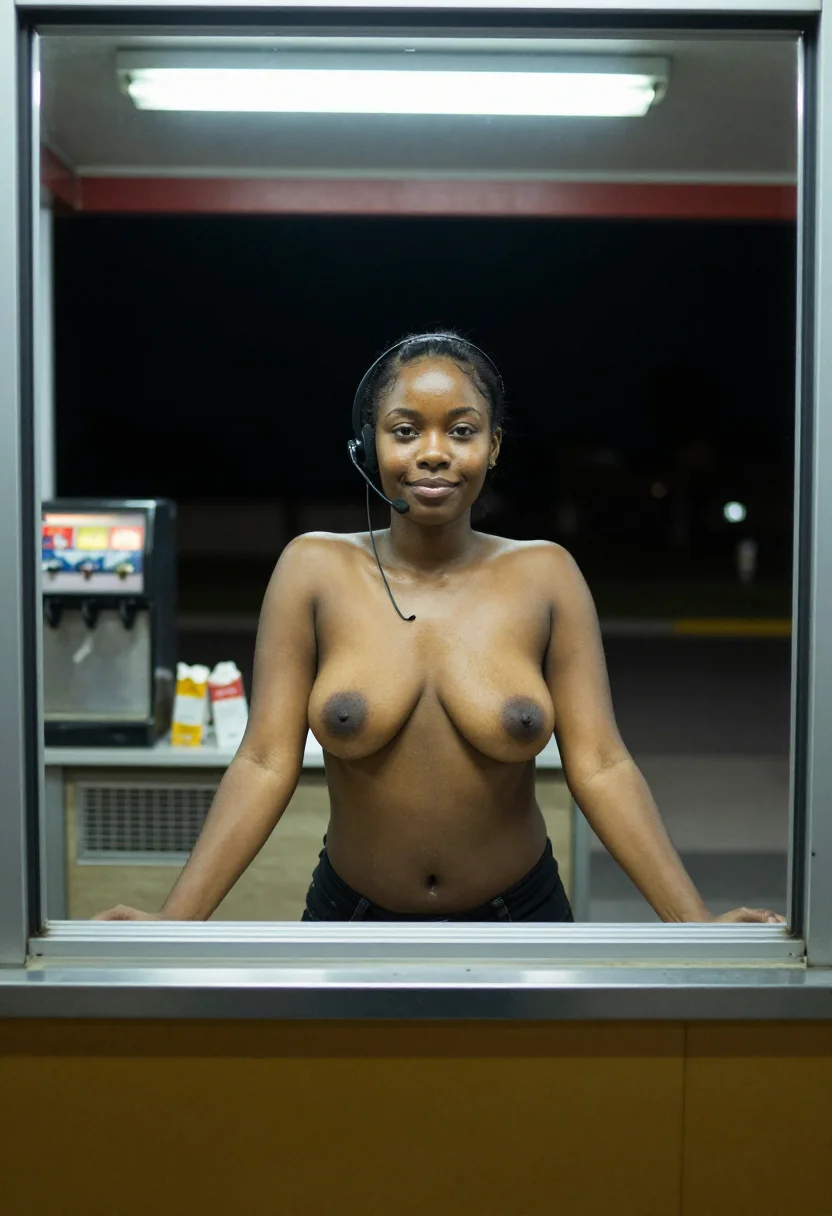
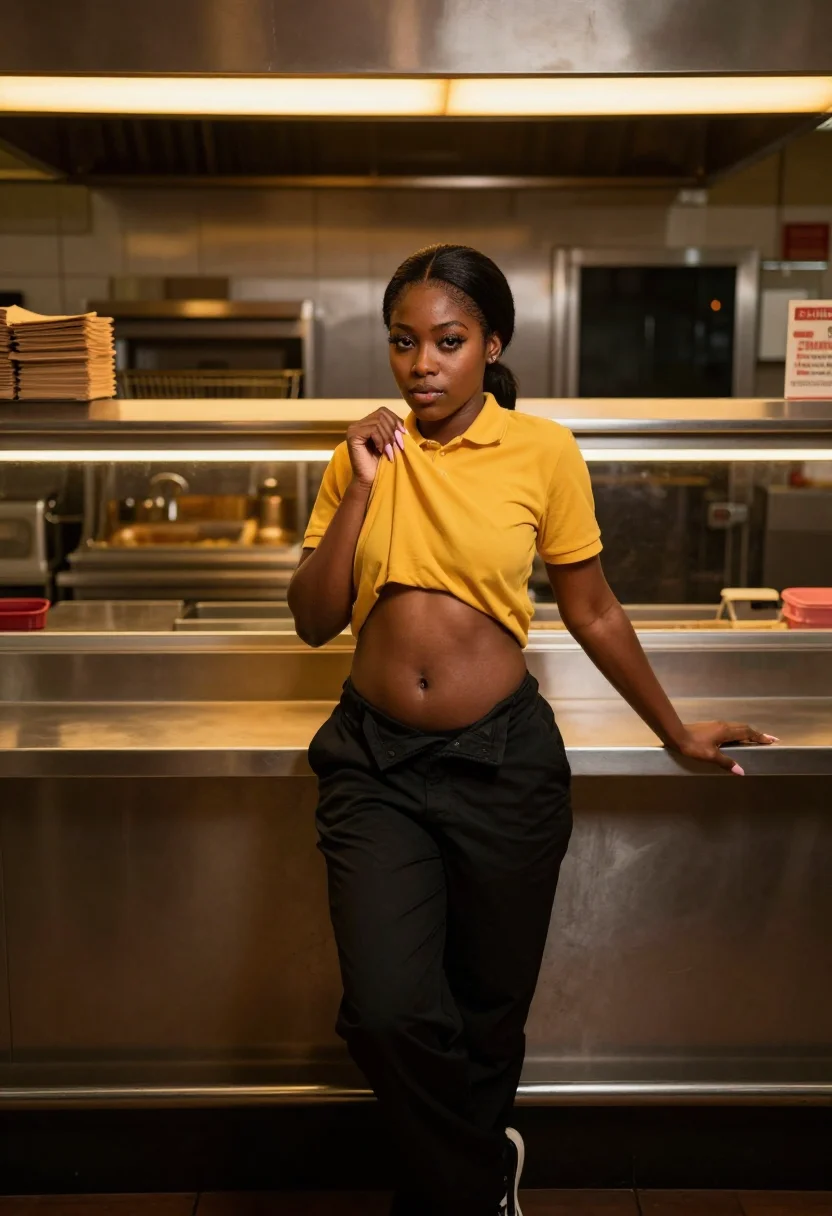
Three parts of one building carry the shift. The service window opens it: cold fluorescent from inside against the black lot beyond, a paper sack held out across the steel sill, a headset clamped over one ear, the blunt dark nose of an idling car filling the lower corner and headlight blue-white raising a specular on a collarbone. The back door takes it to two in the morning under sodium amber — an overturned milk crate, a propped service door on a rubber wedge, a wheeled dumpster against grey breeze block, light held to the upward-facing planes and the asphalt going black. The kitchen after close ends it with the heat lamps: one narrow band of warm orange along the brushed steel of the pass counter, the darkened room returning almost nothing, the figure carrying the whole brightness of the frame against cold metal. One uniform, three lighting logics, one coherent shoot.
The uniform is the wardrobe and the wardrobe is the point. The polo shirt sits at the centre of it: mustard-yellow, collar crooked, sleeves pushed up, the hem knotted at the waist or tucked in on one side; black uniform trousers; a black headset, a maroon visor worn backwards, scuffed sneakers, white ankle socks. Mascara heavy, almond nails lacquered pale pink — the two small vanities the job allows, and the only styling in nine frames. Nothing in the frame carries legible text, a logo or a brand name.
The muse is an AI invention, built for the fast-food uniform and night-shift register: the grease-hazed extractor grille, the condensation beading on a waxed cup, the way a doubled catchlight forms when fluorescent meets headlight — rendered from photographic principles, not drawn or animated. The house casts a range of muses across the register, so it is a body of work, not a single body type.
Frequently asked questions
- What is in the Drive Thru uniform pack?
- Nine frames of one worker across one night shift, in three parts of the same building: the lit service window facing a dark lot, the back door at two in the morning under sodium amber, and the steel pass counter after close under the heat lamps. A mustard-yellow polo, black uniform trousers, a headset, a maroon visor and scuffed sneakers carry the register through all three. Three frames per setting.
- Who is she? Is this a real person or a real restaurant?
- She's an AI muse — generated, synthetic, invented for this register. The uniform here describes what the frames show: the polo rumpled and half-tucked, the visor on backwards, drafted from the first word of the prompt. No real employee, chain or restaurant stands behind any frame.
- Are these real photographs or AI-generated?
- AI-generated. Composition and light behaviour follow photographic principles — cold fluorescent from inside balanced against a black lot and blue-white headlights, sodium amber holding only the upward-facing planes, a narrow band of heat-lamp orange along brushed steel. The result reads as an unstyled candid frame, not an illustration or an anime render.
- What makes this read as amateur rather than glamour?
- Everything is left as the building and the shift left it. The hair is scraped into a bun or pulled back tight or grown out dark at the roots. The expression is flat, deadpan, tired — not a photographer's smile. The light is whatever the building has: fluorescent, sodium, heat lamps, headlights. The details are unglamorous on purpose — a worn rubber floor mat, a grease-hazed extractor grille, an overturned milk crate, a wheeled dumpster, condensation beading on a waxed soda cup. That is what a search for realistic amateur or candid photos is actually asking for, and it is the whole design of this pack.
- Is a real restaurant, brand or chain shown?
- No. Nothing in any frame carries legible text, a logo or a brand name — the palette does the work instead: brushed stainless, mustard yellow, cold fluorescent white, sodium amber and headlight blue-white. No real business, uniform design or person is depicted.
- How is this different from the Gym Flash, Street Flash and Carhop packs?
- Register, not just location. Gym Flash is the athletic body under directional gym light — chalk, sweat, a squat rack. Street Flash is 35mm street photography outdoors, denim and graffiti and hard on-camera flash. Carhop is the styled retro drive-in — the waitress in period dress, bright and deliberate. This one is workwear realism at the far end from all three: a real-feeling job at the wrong hour, unstyled, unretouched, the uniform rumpled because a shift is long and the lot is empty.
- Why does the light change across the nine frames?
- Because a fast-food building lights itself three ways and the shift walks through all of them. The service window is cold fluorescent from inside against the night beyond, with headlight blue-white in the lower corner and a doubled catchlight in each eye. The back door at two in the morning is sodium amber from above, holding light on the upward-facing planes and leaving the asphalt black. The kitchen after close keeps only a narrow band of warm heat-lamp orange along the brushed steel of the pass, so the body carries almost the whole brightness of the frame. Same uniform, three lighting logics, one coherent shoot.
- How is this different from a chat app or a prompt box?
- Different format. A chat runs a conversation and a prompt box generates per prompt — the plainness this register depends on is exactly what is hardest to hold prompt by prompt, because those tools drift toward glamour by default. This pack is a pre-engineered nine-frame series: one uniform, three coordinated settings, three lighting logics, one purchase.
- Can I use the frames once unlocked?
- Personal and creative use. Not for commercial redistribution, not to misrepresent as a real person's photograph, not for use against any individual.
- Is there an age requirement, and is a real person depicted?
- Ovid is for adults 18 and over, and access requires confirming it. Every frame is AI-generated. No real person is named, depicted or impersonated: the muse is synthetic, someone who does not exist.
- Who is in the photos?
- A muse you choose. 32 AI faces, none of them a real person.
Who This Pack Is For
- Anyone searching fast food uniform photos, drive thru photoshoot or night shift portraits who wants one coherent series rather than scattered one-off generations
- Adults who prefer the realistic amateur and candid register to studio glamour
- Photographers studying available light — fluorescent against night, sodium from above, a single warm band on brushed steel
- Artists and illustrators needing photographic reference for a figure under mixed colour-temperature industrial light
- Designers researching how a cheap polo, a knotted hem and a uniform waistband actually sit on the body
- Writers of contemporary and working-life fiction who need a consistent visual face for a fictional character
- Digital collage artists working in a brushed stainless, mustard yellow and sodium amber palette
- Adults curious about AI workwear and amateur photoshoot registers at an accessible entry price
About Ovid
Ovid is a house of pictures that were never taken. Most AI image tools ship one giant catalog of poses and aesthetics; the output looks like every other generated image on the internet. Ovid goes the other way. Each pack is a single editorial brief — light, styling, scene composed in the grammar of the great fashion editorials — hand-curated against real references and tested before it ships. Free preview before you pay. Packs are one-time. No template generator, no feed. A fashion house, not a catalog.