/fashion-week-backstage
Fashion Week Backstage Muse — Nine AI Photos
Make it with your museFashion Week Backstage Muse — Nine AI Photos
Open this world on the wall, and make it with your muse.
all 9 frames of her, in this world ↓
The Backstage Register: Between Looks by Production Schedule
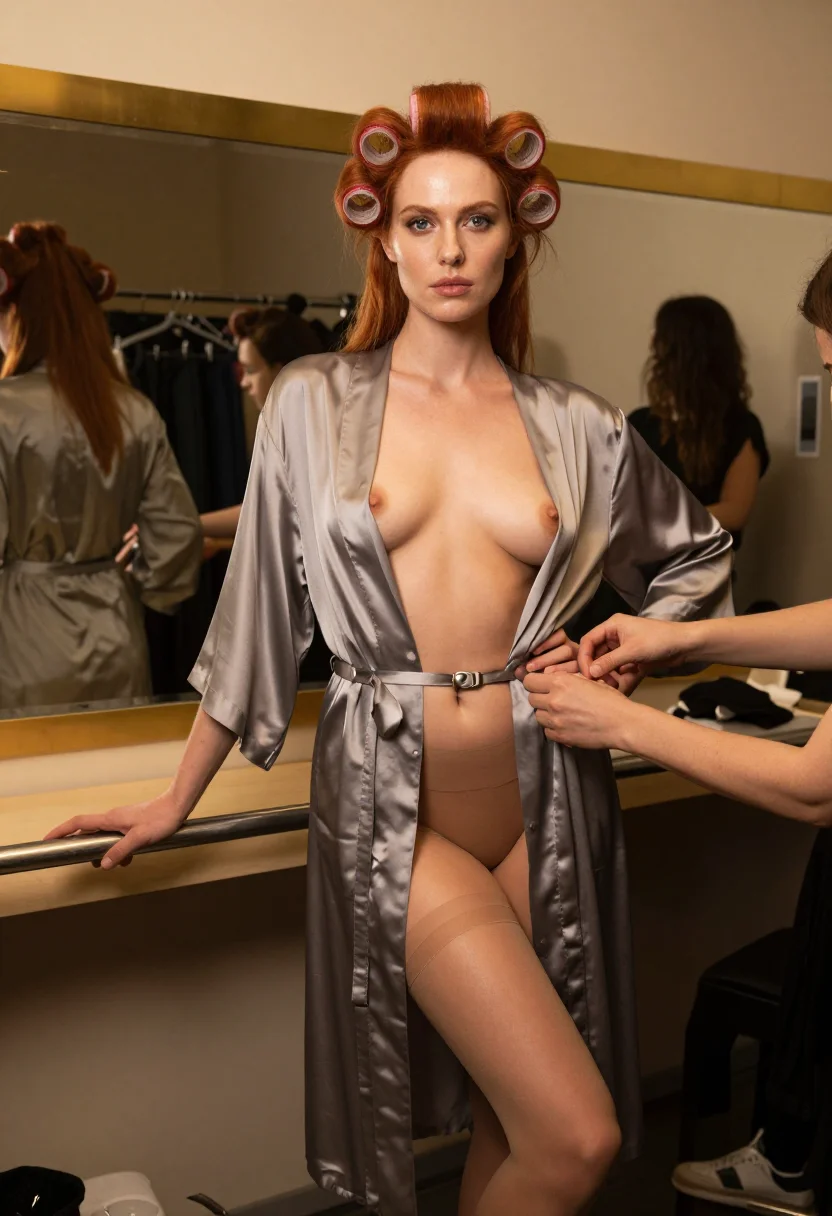
Backstage is the one place in fashion where the change of clothes is administrative. A show runs on a clock, a model wears three looks, and the interval between them is measured in seconds — so the change happens where she is standing, in front of a rail, with dressers working around her. That is the whole premise and it needs no invention: the pack simply photographs the interval instead of the runway. Rollers stay in, tape stays on the floor, and the clothes on the rail are more carefully lit than she is.
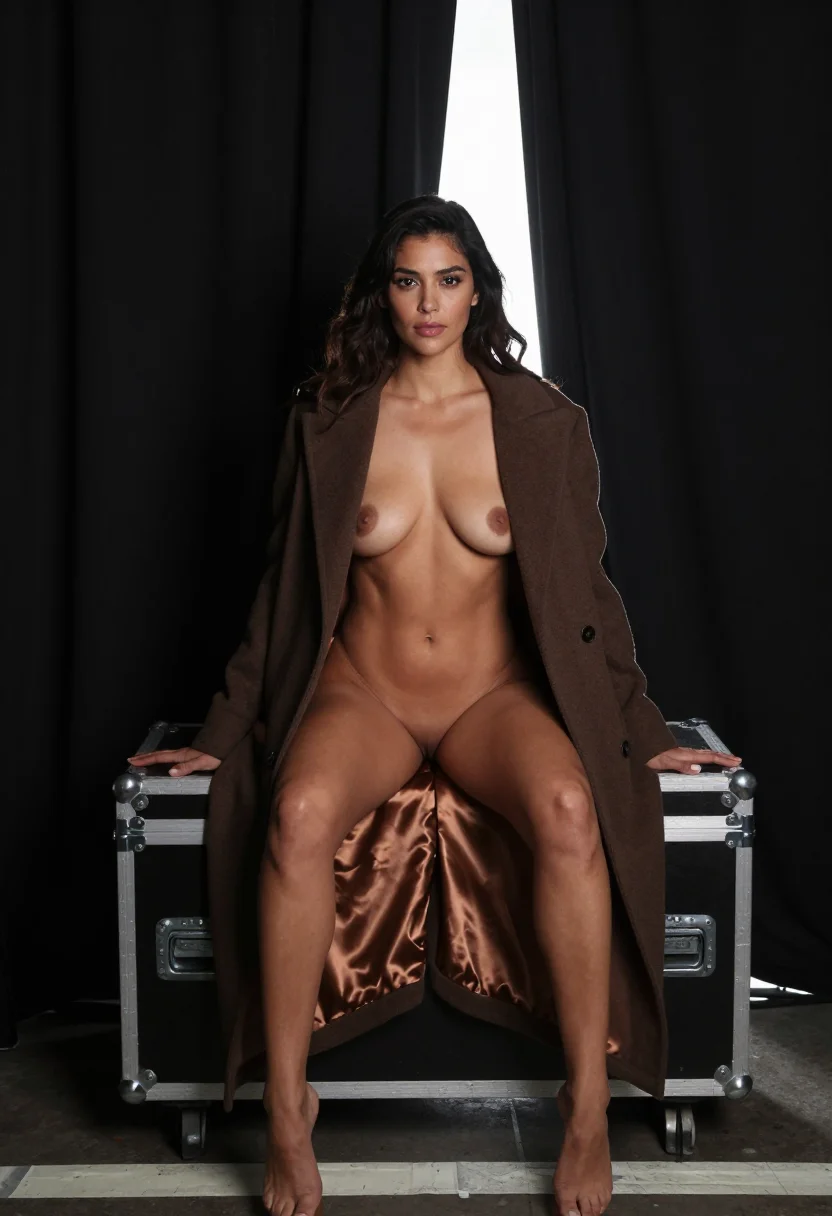
Three light situations carry the sequence and they collapse in brightness as it runs. The mirror wall is hardest and warmest — bulbs straight at the face, colour bouncing back off a solid rail of garments, every edge crisp. The quick change is the same bulbs arriving sideways, broken up by hanging clothes into slats of warm light, softened further by hairspray haze in the air. The runway mouth is near-black: the backstage falls away entirely and a single white glare comes through the curtain's gap, catching the coat's lining and one side of her.
The wardrobe runs one direction and never doubles back: robe worn open, then the half-zipped dress at the quick change, then the second look's open coat. Every frame is written before it is rendered — the rail, the rollers, the tape, the source of light — and composed from the first pixel forward rather than lifted off anyone's photograph. The dresser is hands only; no second face appears anywhere in the set.
The house casts a range of muses through this register: pale skin running hot under the mirror bulbs, deep bronze reading superbly against the runway's white glare, hair in rollers then loose. Everything renders photographically — real bulb specular, real haze scatter, real silk-lining sheen, real hard glare through a narrow gap. Nine frames read as one continuous show from the mirror wall to the curtain.
Frequently asked questions
- What is in the Fashion Week Backstage pack?
- Nine frames from one show, following a single model through it. She starts at the dressing rail and mirror wall in a robe worn open over the first look's slip, rollers in her hair, a hand on the rail. She goes through the quick change behind the rail, one hand on its steel while the next dress waits on its hanger beside her. She ends at the runway mouth in the dark, in the second look's open coat, the white glare of the runway past the curtain's gap. Three frames per stage, one continuous show.
- Is anyone else in the frames?
- No second face anywhere in the pack. A dresser's hands appear — pinning at her hip in the first stage, holding the next dress on its hanger by an arm out of frame in the second — because backstage is not a solitary place and pretending otherwise would falsify the register. But they stay hands and forearms only. She is the only person in the set.
- What does she wear across the set?
- A robe worn open over the first look's slip, then the dress half-zipped during the quick change, then the second look's coat worn open over a black bodysuit at the runway mouth. Rollers stay in her hair through the first two stages. Tape and pins are on the floor throughout, because they always are.
- What are the three stages?
- The Mirror Wall — standing with one hand on the dressing rail and the other holding the robe's edge, the rail's garments a wall of colour behind, hard warm bulbs on her face. The Quick Change — behind the rail with her weight on one leg and her free hand at her hip, mirror bulbs throwing side light through the hanging garments, hairspray haze in the air. The Runway Mouth — at three-quarters in the dark, one hand holding the coat's edge, a strip of tape marking her spot, the runway's white glare through the curtain's gap.
- Are these real photographs or AI-generated?
- AI-generated, built on photographic principles. Three light situations carry the pack: hard warm bulbs straight at the face with colour bouncing off a rail of garments, the same bulbs filtered sideways through hanging clothes into a haze of hairspray, and finally near-darkness with one hard white glare coming through a gap. Silk lining, steel rail, mirror glass and skin each answer those correctly. It reads as backstage reportage, not as an illustration.
- Do I need to upload a selfie, and what if it isn't a good one?
- Uploading is optional — skip it and the house casts its own muse. If you do upload, an ordinary phone selfie is enough: front-facing, decent light, nothing professional. The free preview shows the result on your own face before you decide anything, so you judge the likeness rather than guess at it.
- Is there any brand, logo or legible text in the frames?
- None. The garments on the rail belong to no house, the coat carries no label, and nothing on the floor or the mirror is readable. The show is deliberately unnamed — the register is a fashion week, not a particular one, and the clothes are there to give the light something to bounce off.
- How is this different from the Couture Fitting pack?
- Couture Fitting is slow and private: one salon, one client, a toile pinned on the body, a chandelier and daylight, hours available. This is the opposite tempo — a schedule, a rail, a haze of hairspray, and a change that has to happen in seconds.
- How is this different from a chat app or a prompt box?
- Different product. A chat is something you steer; a prompt box is refined one frame at a time. This is a pre-engineered nine-frame series — one show, three stages, one continuous evening — delivered whole for one payment. Better if you want a coherent set; worse if you want to negotiate every image.
- Can I use the frames once unlocked?
- Personal and creative use. Not for commercial redistribution, not to present as a real person's photograph, and not for use against any individual.
- Is there an age requirement?
- Ovid is for adults 18 and over, and access requires confirming it. The muse is an adult woman composed from a written brief rather than photographed, so she is not a real person; if you cast your own face into the set, that likeness is yours and yours only.
- Who is in the photos?
- A muse you choose. 32 AI faces, none of them a real person.
Who Reaches for the Backstage Register
- Anyone searching fashion week backstage or backstage photography who wants the register composed as a set rather than scavenged one image at a time
- People who want nine frames that hold one show, one evening and three collapsing light situations instead of nine unrelated prompt results
- Fans of editorial and runway imagery looking for the register rendered photographically rather than illustrated
- Photographers studying hard bulb light, haze scatter and a single hard glare from a gap in one continuous set
- Writers and worldbuilders who need one consistent character inside a fashion-industry storyline
- Collage and moodboard artists who need photographic-quality backstage material rather than studio glamour
- Adults curious about how a production register reads when it is composed as a nine-frame series
About Ovid
Ovid is a house of pictures that were never taken. Most AI image tools ship one giant catalog of poses and aesthetics; the output looks like every other generated image on the internet. Ovid goes the other way. Each pack is a single editorial brief — light, styling, scene composed in the grammar of the great fashion editorials — hand-curated against real references and tested before it ships. Free preview before you pay. Packs are one-time. No template generator, no feed. A fashion house, not a catalog.