/henna-night
Henna Night Muse — Nine AI Photos
Make it with your museHenna Night Muse — Nine AI Photos
Open this world on the wall, and make it with your muse.
all 9 frames of her, in this world ↓
The Henna Night Register: Dark Pattern, Gold, Candles Burning Down
The henna night belongs to the women. The evening before a wedding, an adult bride sits on cushions while the others work paste onto her hands and feet in patterns that will take hours to dry and days to fade, and for that whole evening she is the room's occupation — held, turned, patterned and admired by people who have done this for each other all their lives. This pack takes that hour at its word: the ritual is the reason, the ornament is the costume, and the bed at the end of the night is where the evening was always going.
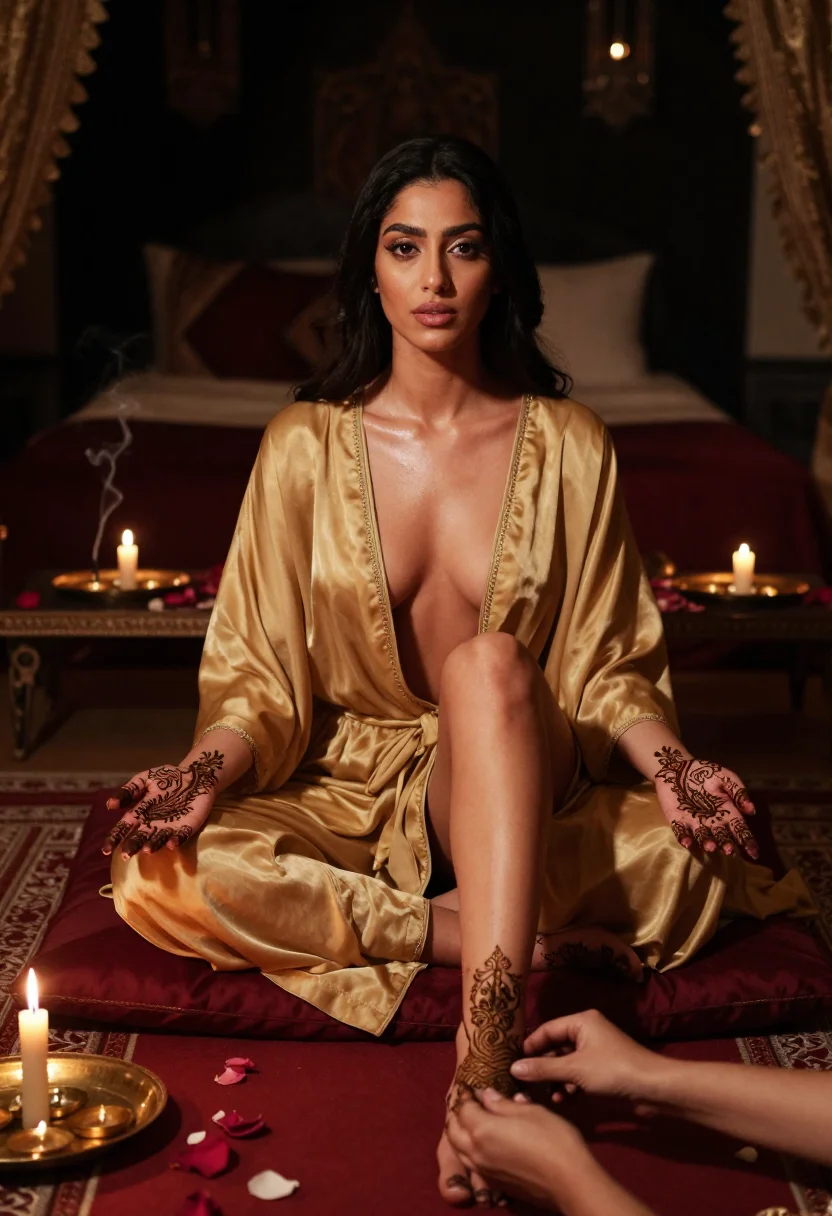
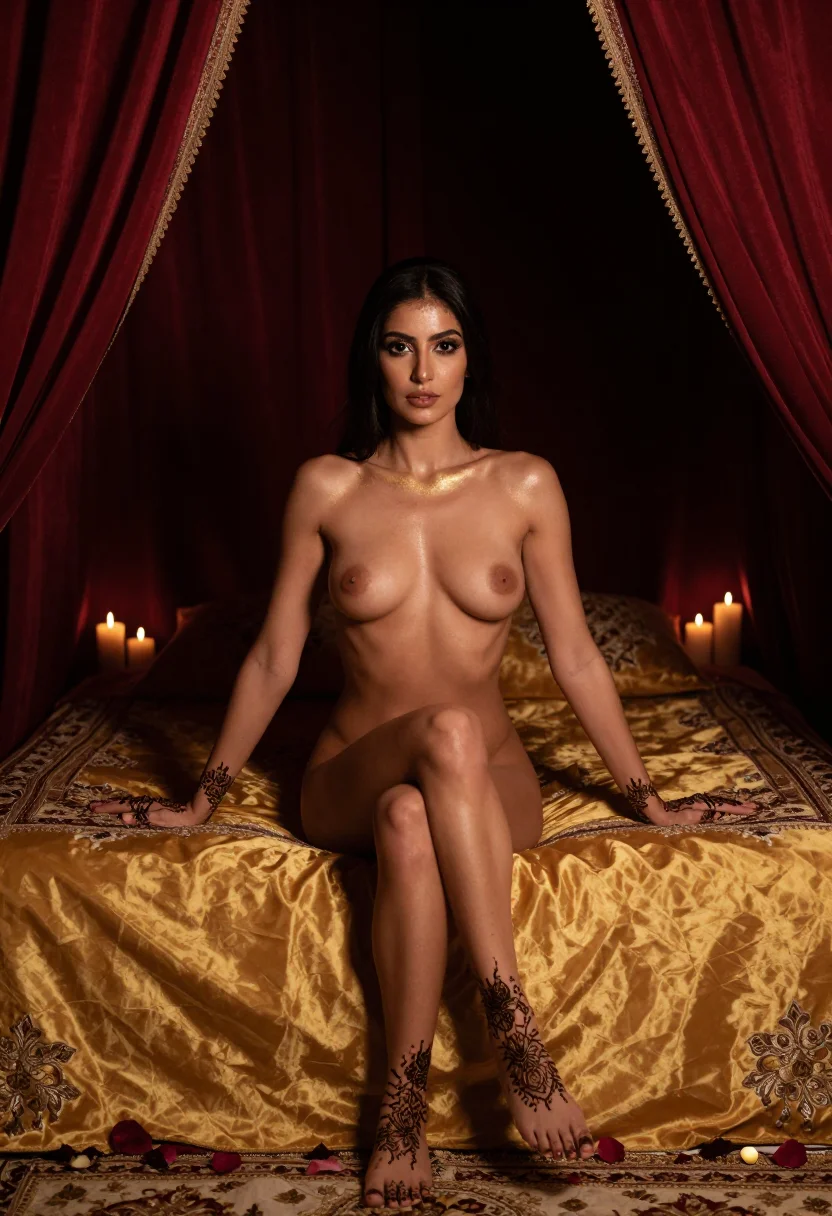
Three stages run the sequence and the light goes down with them. The first is busiest — a gold kaftan worn open, candles standing in brass on the low tables, rose petals scattered on red cushions, and hands entering at the frame's edge to finish the last of the ankle. The second empties the room: the kaftan laid over the cushions, the women gone, henna dark on hands and feet, gold at throat, wrists and brow. The third is the bed itself, canopy hangings drawn half open, candles burned low enough that the pattern on her wrists is the brightest drawn thing in the frame.
Everything is staged as rest rather than display. Her patterned palms turn up on her thighs while the paste dries because that is what you do with fresh henna; her weight goes back on one hand; the other palm sits on a knee, a pillow, a hip. The recline on the bridal bed is framed from the head end at three-quarters, so the canopy and the cover carry the composition. No limb is aimed at the lens at any point in the set.
The wardrobe sequence is stated rather than narrated: kaftan worn open over a white cotton slip, then laid over the cushions with henna and gold left on, then simply the slip on the embroidered cover with the kaftan's gold over the bed's foot. All nine frames are photographic in construction and AI-generated in execution — the muse is composed from a written brief, and no real person was photographed to produce any of them.
Frequently asked questions
- What is in the Henna Night pack?
- Nine frames from a bride's henna night. Three seated on the cushions in a gold kaftan worn open over a white cotton slip while the women's hands finish the pattern at her ankle, three on the cushions with the kaftan laid aside and only henna, slip and gold left, three on the bridal bed under a canopy with its hangings drawn half open. One payment for the set.
- Are these real photographs or AI-generated?
- AI-generated, built on photographic principles. Candles in brass sit low on the tables, so the light rakes upward across her and dies quickly into the room's hangings — dark henna lines read as fine drawn detail on lit skin, gold at the throat and wrists throws small hard speculars, rose petals on red cushions take a soft warm bounce. It reads as a photograph, not as an illustration.
- Is this an AI tool that alters a real photo of me?
- No. Each frame is written first — the kaftan, the henna, the candles, the bed — and composed from the first pixel forward. Nothing is lifted from an existing image, because no existing image is read.
- Why the henna night?
- Because the ritual is the licence. On the night before the wedding the bride's body is the object of the whole gathering's attention — prepared, patterned, oiled and adorned by other women — and it is the one occasion where being looked at closely is the point of the evening rather than a transgression against it. By the time the bed is reached the ceremony has done its work and only the ornament is left.
- Who are the hands in the first frames?
- The women of the henna night, and they are kept as hands only. They enter at the frame's edge to lay the last of the pattern on her ankle and never resolve into faces or figures — the pack has exactly one subject, and the attendants exist as an action rather than as characters.
- What are the three settings?
- The Application — cushions in deep red, brass candles on low tables, rose petals, the gold kaftan open, hands at the frame's edge finishing the ankle. The Cushions — the kaftan laid over the cushions, henna on hands and feet, gold at throat, wrists and brow the only ornament left, the bridal bed visible beyond. The Bed — an embroidered cover, a canopy with its hangings drawn half open, candles burned low, the kaftan's gold over the bed's foot.
- What does she wear across the set?
- A gold kaftan worn open over a white cotton slip in the first third, with the henna already dark on her hands and feet. In the second the kaftan is laid over the cushions and the gold is the only ornament left on. On the bed there is the slip, the patterning and the gold.
- Why does the henna matter photographically?
- Because it is drawing on a curved surface. Fine dark lines wrapped over palms, wrists and ankles describe form the way a contour drawing does — every bend of a finger and turn of an ankle is mapped by the pattern itself, so candlelight and line do the modelling together. It is the reason body art reads so well in low warm light.
- Do I need to upload a selfie?
- It is optional. One clear front-facing photo casts the muse in your likeness across all nine frames; skip it and the house casts its own. Your selfie steers the face — it is never the image being altered.
- How is this different from a chat app or a prompt box?
- Different product. A chat is something you steer; a prompt box is refined one frame at a time. This is a pre-engineered nine-frame series — one night, three stages, one continuous pattern — delivered whole for one payment. Better for a coherent set, worse if you want to negotiate every image.
- Can I use the frames once unlocked?
- Personal and creative use. Not for commercial redistribution, not to present as a real person's photograph, and not for use against any individual.
- Is there an age requirement?
- Ovid is for adults 18 and over, and access requires confirming it. The muse is a composed synthetic adult woman, written and AI-generated rather than photographed, so she is not a real person; if you choose to cast your own likeness from a selfie, that likeness is yours and yours alone.
- Who is in the photos?
- A muse you choose. 32 AI faces, none of them a real person.
Who Reaches for the Henna Night Register
- People searching henna night photos who want the ritual's own room rather than a studio set
- Photographers studying low candlelight raking upward across skin and fine dark linework
- Body-art and tattoo people looking at how contour pattern maps a curved surface in warm light
- Worldbuilders and writers needing one consistent adult muse across a single ceremonial night
- Painters working on interiors who want reference for gold, red cushions and petals under burning candles
- Collage artists assembling a bridal-henna moodboard that has to hold one grade across nine images
- Adults who want the ceremonial register of AI photography at an accessible entry price
About Ovid
Ovid is a house of pictures that were never taken. Most AI image tools ship one giant catalog of poses and aesthetics; the output looks like every other generated image on the internet. Ovid goes the other way. Each pack is a single editorial brief — light, styling, scene composed in the grammar of the great fashion editorials — hand-curated against real references and tested before it ships. Free preview before you pay. Packs are one-time. No template generator, no feed. A fashion house, not a catalog.