/item-song
Item Song Muse — Nine AI Photos
Make it with your museItem Song Muse — Nine AI Photos
Open this world on the wall, and make it with your muse.
all 9 frames of her, in this world ↓
The Item Song Register: After Wrap, the Throne Hers
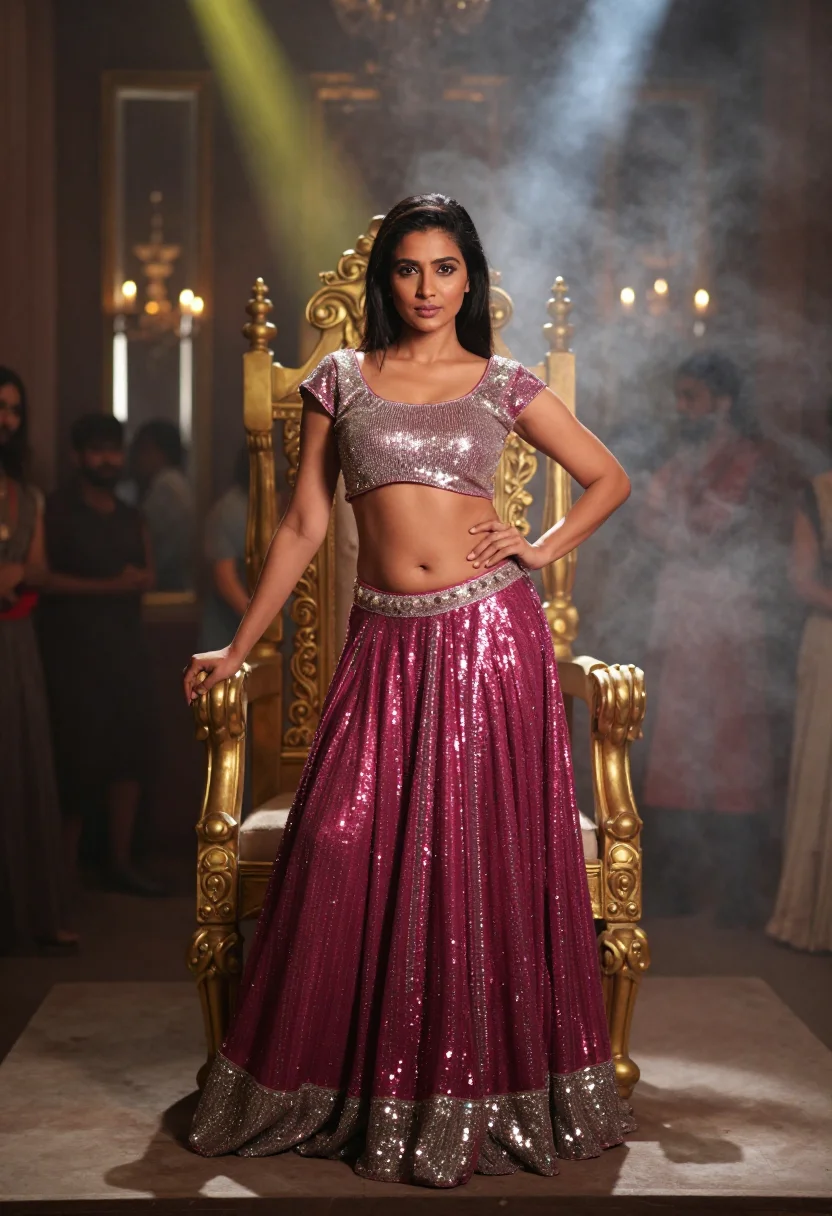
The item song's whole number is built for the camera — a sequin ghagra-choli under drifting smoke and coloured lights, a throne prop waiting under the chandeliers. These nine frames follow the set from the number's own bollywood stage through the back corridor to after wrap: lit stage first, then an oversized crew jacket over the ghagra in the corridor, then the throne once the crew is gone.
Light carries the arc. Magenta and gold beams cut the smoke on the lit stage, sequins throwing hard points; a single work light flattens the corridor to plywood and cable; after wrap the set's coloured lights are left running, softer now with the smoke thinning, the mirrors dark and the crew a memory. This is a bollywood dancer portrait built on the mechanics of a real film set, not a studio backdrop dressed up as one.
The item song photo search ends here honestly, and it holds for the wider item number, sequin ghagra, ghagra choli, smoke set and throne prop register too: nothing in these nine frames was lifted off a real photograph of a real set. Each is written before it is rendered — the smoke, the corridor, the throne — and composed from the first pixel forward. All nine are photographic in construction and AI-generated in execution; no real person was photographed to produce any of them.
Frequently asked questions
- What's in the Item Song pack?
- Nine frames across one number's arc: three on the raised set in a sequin ghagra-choli under smoke and coloured beams, three in the set's back corridor with an oversized crew jacket over the ghagra, and three on the throne prop after wrap, the coloured lights left on and the smoke thinning. Three frames per stage, one payment for the set.
- Does this work from an existing photo of someone?
- No. Nothing is generated by altering an existing image, because no existing image is read. Each frame is written first — the smoke, the throne, the coloured beams, the tape marks on the floor — then composed by the model from the first pixel forward. It is not something performed on a real photograph of a real person.
- Are these real photographs or AI-generated?
- AI-generated, built on photographic principles. Magenta and gold beams cut through drifting smoke on the lit stage; a single work light picks out plywood and cable in the corridor; the throne stage lets the set's own coloured wash fall soft across silk and skin as the smoke thins. It reads as a film-set photograph, not an illustration.
- What are the three stages of the number?
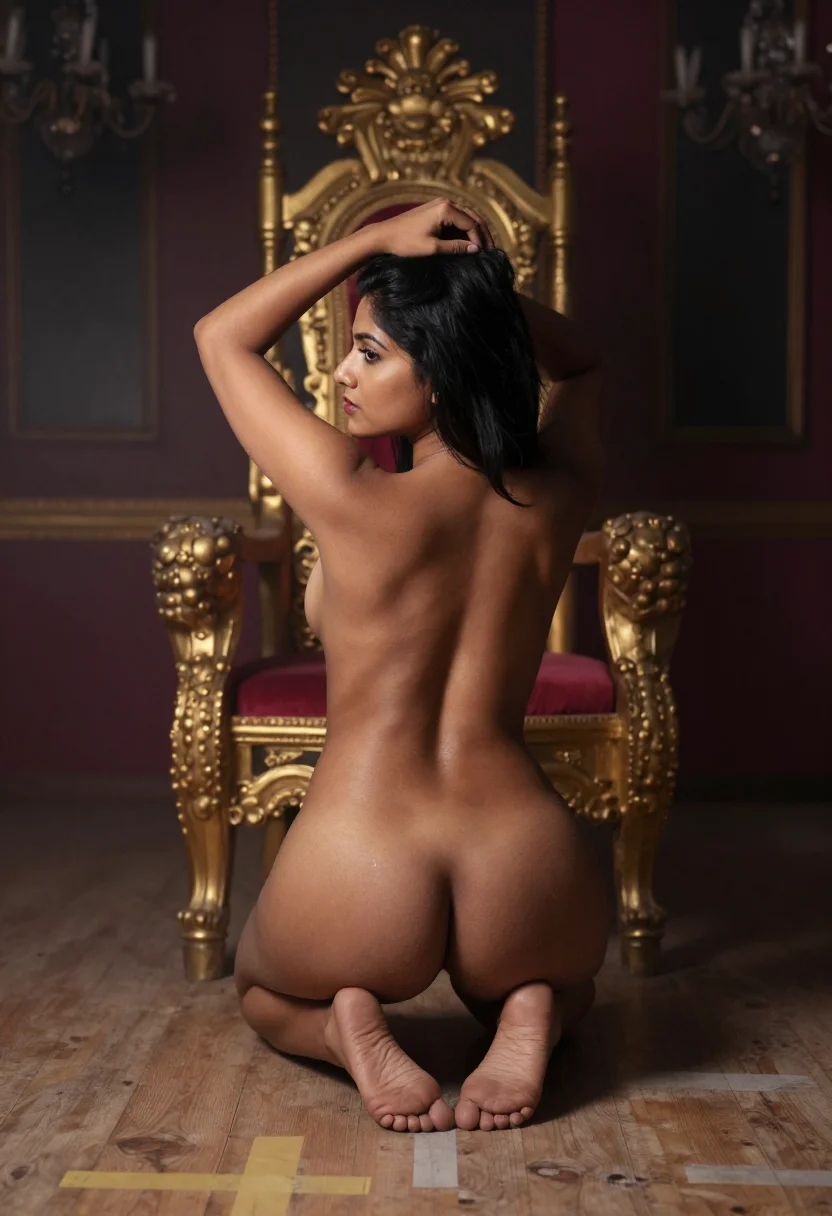
- Lit stage — the sequin ghagra-choli under smoke and coloured beams, one hand on the throne prop's gilt arm. Corridor — the choli under an oversized crew jacket, one work light on plywood and cables. After wrap — seated on the throne prop, one hand on the gilt arm, the set's coloured lights and chandeliers left on around her.
- What's the wardrobe?
- A sequin ghagra-choli built for the camera — mirrors, chandeliers and sequins throwing points under the lights — worn through the lit-stage frames, then an oversized crew jacket over it in the corridor and on the throne.
- How is this different from a chat app or a prompt box?
- Different product. A chat is something you steer one turn at a time; a prompt box is refined image by image. This is a pre-engineered nine-frame series — one number, three stages, the throne after wrap — delivered whole for one payment. Better for a coherent set, worse if you want to negotiate every frame.
- Do I need to upload a selfie?
- It's optional. One clear front-facing photo casts the muse in your likeness across all nine frames; skip it and the house casts its own. Your selfie steers the face — it is never a photo that gets altered.
- Can I use the frames once unlocked?
- Personal and creative use. Not for commercial redistribution, not to present as a real person's photograph, and not for use against any individual.
- Is there an age requirement?
- Ovid is for adults 18 and over, and access requires confirming it. The muse is composed from a written brief rather than photographed, so she is not a real person; if you cast your own face into the set, that likeness is yours and yours only.
- Who is in the photos?
- A muse you choose. 32 AI faces, none of them a real person.
Who Reaches for the Item Song Register
- People searching item song photos who want the after-wrap version, not a generic dance-floor set
- Photographers studying how magenta-and-gold stage beams and a single work light shape the same figure differently
- Costume and film people looking at how a sequin ghagra-choli reads on the set versus under a crew jacket
- Writers and worldbuilders who need one consistent character across a single number's full arc
- Anyone building a bollywood dancer moodboard that has to hold one grade across nine images
- Collage artists who need photographic-quality smoke-and-throne material rather than studio glamour
- Adults curious about the item-number register of AI photography at an accessible entry price
- Fans of the back corridor film-set aesthetic who want the crew-gone version rather than the number itself
About Ovid
Ovid is a house of pictures that were never taken. Most AI image tools ship one giant catalog of poses and aesthetics; the output looks like every other generated image on the internet. Ovid goes the other way. Each pack is a single editorial brief — light, styling, scene composed in the grammar of the great fashion editorials — hand-curated against real references and tested before it ships. Free preview before you pay. Packs are one-time. No template generator, no feed. A fashion house, not a catalog.