/khajuraho-apsara
Khajuraho Muse — Nine AI Photos
Make it with your museKhajuraho Muse — Nine AI Photos
Open this world on the wall, and make it with your muse.
all 9 frames of her, in this world ↓
The Khajuraho Register: The Temple's Own Carved Body
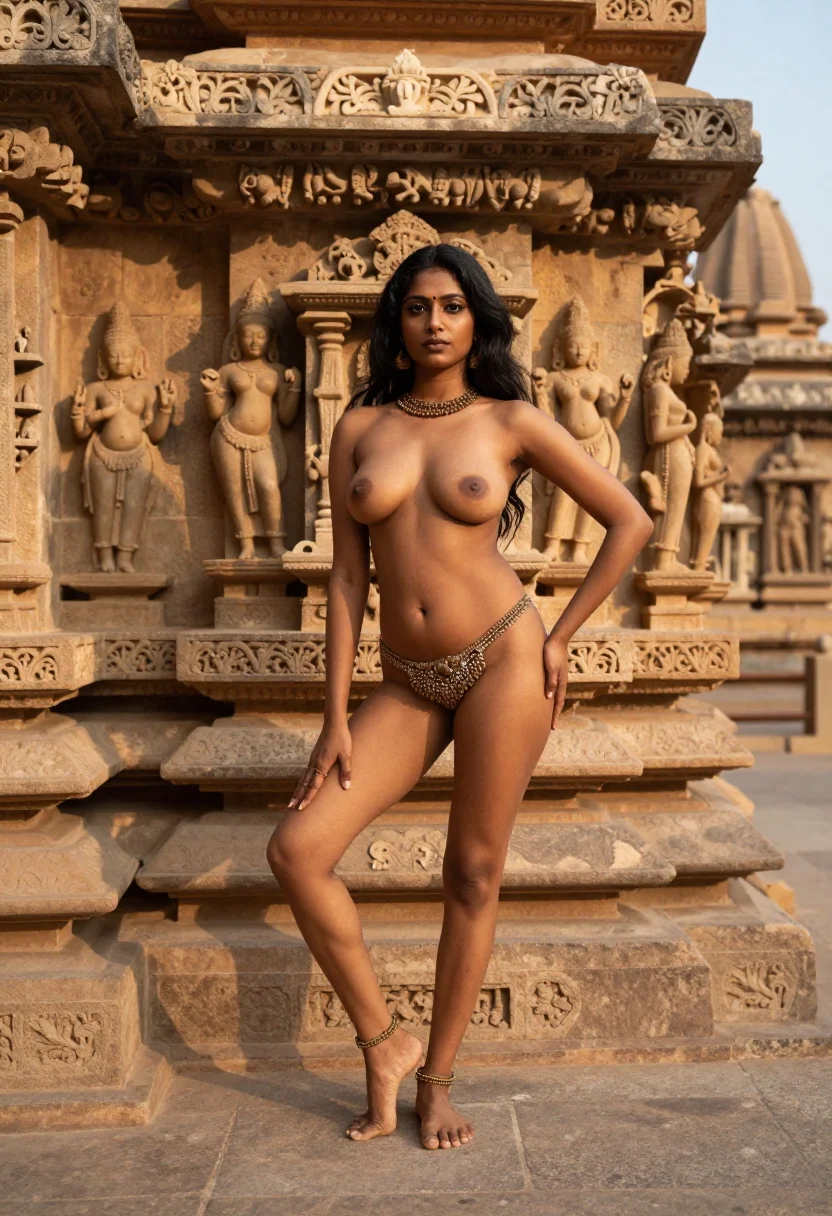
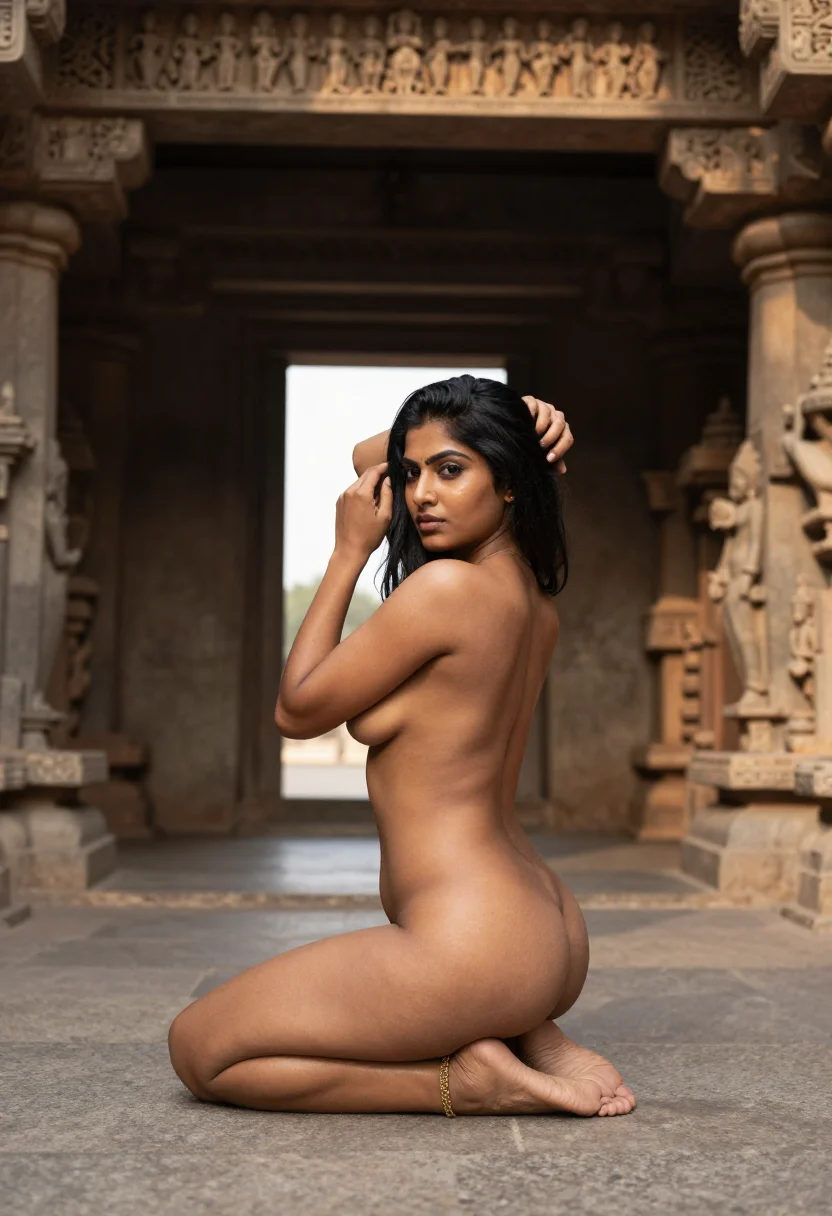
Khajuraho's own sandstone walls are carved with this figure, and the pose is the register: a celestial dancer held on a temple plinth, the same curve repeated in the carved figures behind her. These nine frames take that pose off the wall and hold it on a living plinth — jewelled girdle first, the wrap and girdle turned next, then seated on the sanctum's step with the doorway's daylight the only light left.
Sandstone's warm ochre carries the afternoon frames while the sanctum drops into a darker, cooler register lit by one warm slab of daylight through the doorway. The carved figures behind her are never mere backdrop — they hold the same pose, close enough almost to touch, which is the entire point of an apsara taken off the temple's own wall.
The khajuraho photo search ends here honestly, and it holds for the wider celestial dancer, sandstone temple, temple plinth, apsara portrait, carved figure and temple sanctum register too: nothing in these nine frames was lifted off a real photograph of a real temple. Each is written before it is rendered — the plinth, the carving, the sanctum — and composed from the first pixel forward. All nine are photographic in construction and AI-generated in execution; no real person was photographed to produce any of them.
Frequently asked questions
- What's in the Khajuraho pack?
- Nine frames across one temple register: three on the sandstone plinth holding the celestial dancer's pose in a jewelled girdle over a silk wrap, necklace and anklets, three turned to show the back's curve in the wrap and girdle with the necklace laid aside, and three on the sanctum's stone step in a pale silk sash with the anklets. Three frames per stage, one payment for the set.
- Does this work from an existing photo of someone?
- No. Nothing is generated by altering an existing image, because no existing image is read. Each frame is written first — the plinth, the carved wall, the sanctum's doorway light — then composed by the model from the first pixel forward. It is not something performed on a real photograph of a real person.
- Are these real photographs or AI-generated?
- AI-generated, built on photographic principles. Afternoon light sits warm ochre on the sandstone; the carved figures behind hold real depth rather than a flat backdrop; the sanctum's doorway throws a single warm slab of daylight across the stone step. It reads as a temple photograph, not an illustration.
- What are the three stages of the register?
- Plinth — the celestial dancer's pose held, weight on one hip, a jewelled girdle, necklace and anklets, one hand on the plinth's carved edge. Column — the wrap and girdle, the pose turned to show the hip's swing, one hand at the girdle's chain against a carved column. Sanctum — in the inner light, anklets on, seated on the stone step in a pale sash, the girdle laid beside her.
- What's the wardrobe?
- A jewelled girdle at the hips over a silk wrap and a bead necklace as the register's own ornament, plus anklets that carry through every stage — the last things on in every frame.
- How is this different from a chat app or a prompt box?
- Different product. A chat is something you steer one turn at a time; a prompt box is refined image by image. This is a pre-engineered nine-frame series — one temple, three stages, the carved register throughout — delivered whole for one payment. Better for a coherent set, worse if you want to negotiate every frame.
- Do I need to upload a selfie?
- It's optional. One clear front-facing photo casts the muse in your likeness across all nine frames; skip it and the house casts its own. Your selfie steers the face — it is never a photo that gets altered.
- Can I use the frames once unlocked?
- Personal and creative use. Not for commercial redistribution, not to present as a real person's photograph, and not for use against any individual.
- Is there an age requirement?
- Ovid is for adults 18 and over, and access requires confirming it. The muse is composed from a written brief rather than photographed, so she is not a real person; if you cast your own face into the set, that likeness is yours and yours only.
- Who is in the photos?
- A muse you choose. 32 AI faces, none of them a real person.
Who Reaches for the Khajuraho Register
- People searching khajuraho photos who want the carved-plinth version, not a generic temple set
- Photographers studying how warm sandstone light differs from the sanctum's single doorway slab
- Sculpture and art-history people looking at how the apsara's pose translates from stone to a living figure
- Writers and worldbuilders who need one consistent character across a single temple's registers
- Anyone building a temple sculpture moodboard that has to hold one grade across nine images
- Collage artists who need photographic-quality carved-stone material rather than studio glamour
- Adults curious about the khajuraho-temple register of AI photography at an accessible entry price
- Fans of the celestial dancer aesthetic who want the plinth version rather than a museum photograph
About Ovid
Ovid is a house of pictures that were never taken. Most AI image tools ship one giant catalog of poses and aesthetics; the output looks like every other generated image on the internet. Ovid goes the other way. Each pack is a single editorial brief — light, styling, scene composed in the grammar of the great fashion editorials — hand-curated against real references and tested before it ships. Free preview before you pay. Packs are one-time. No template generator, no feed. A fashion house, not a catalog.