/mahjong-parlour
Mahjong Parlour Muse — Nine AI Cheongsam Photos
Make it with your museMahjong Parlour Muse — Nine AI Cheongsam Photos
Open this world on the wall, and make it with your muse.
all 9 frames of her, in this world ↓
The Mahjong Parlour Register: Where the Game Ends
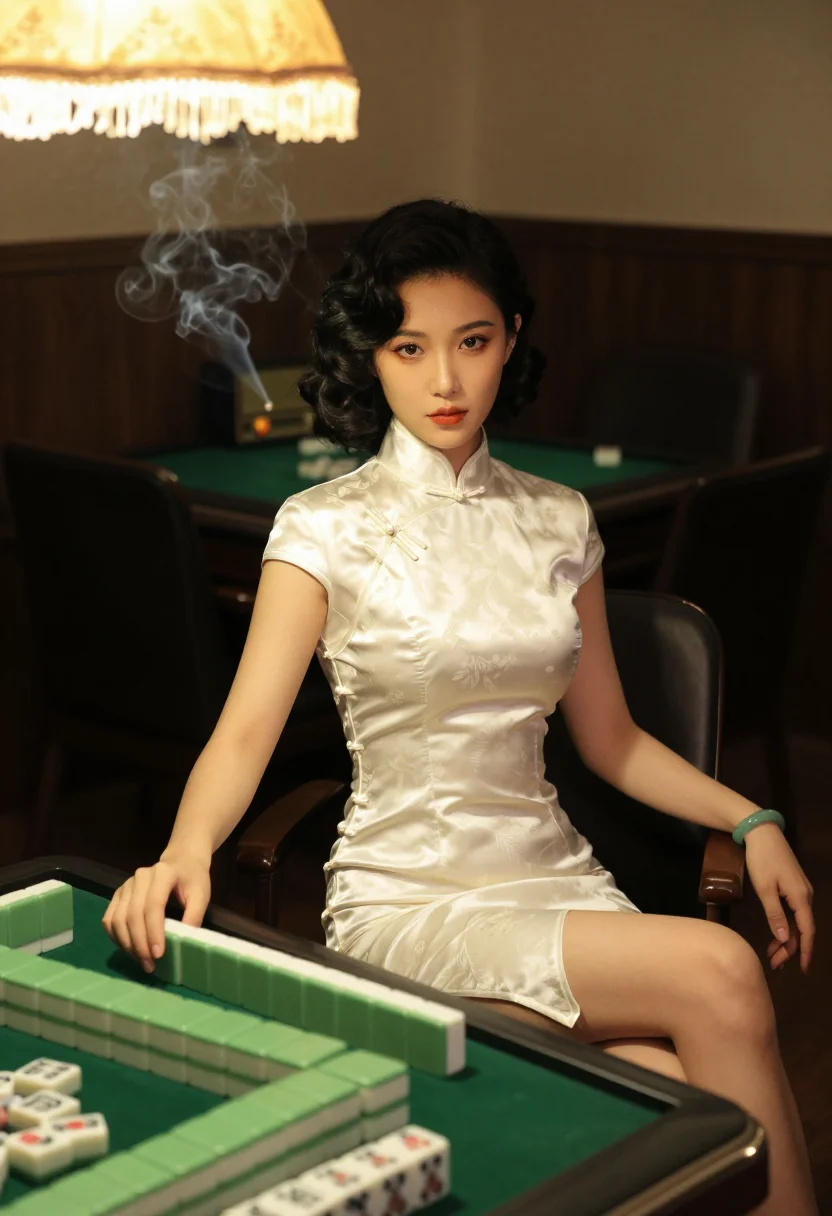
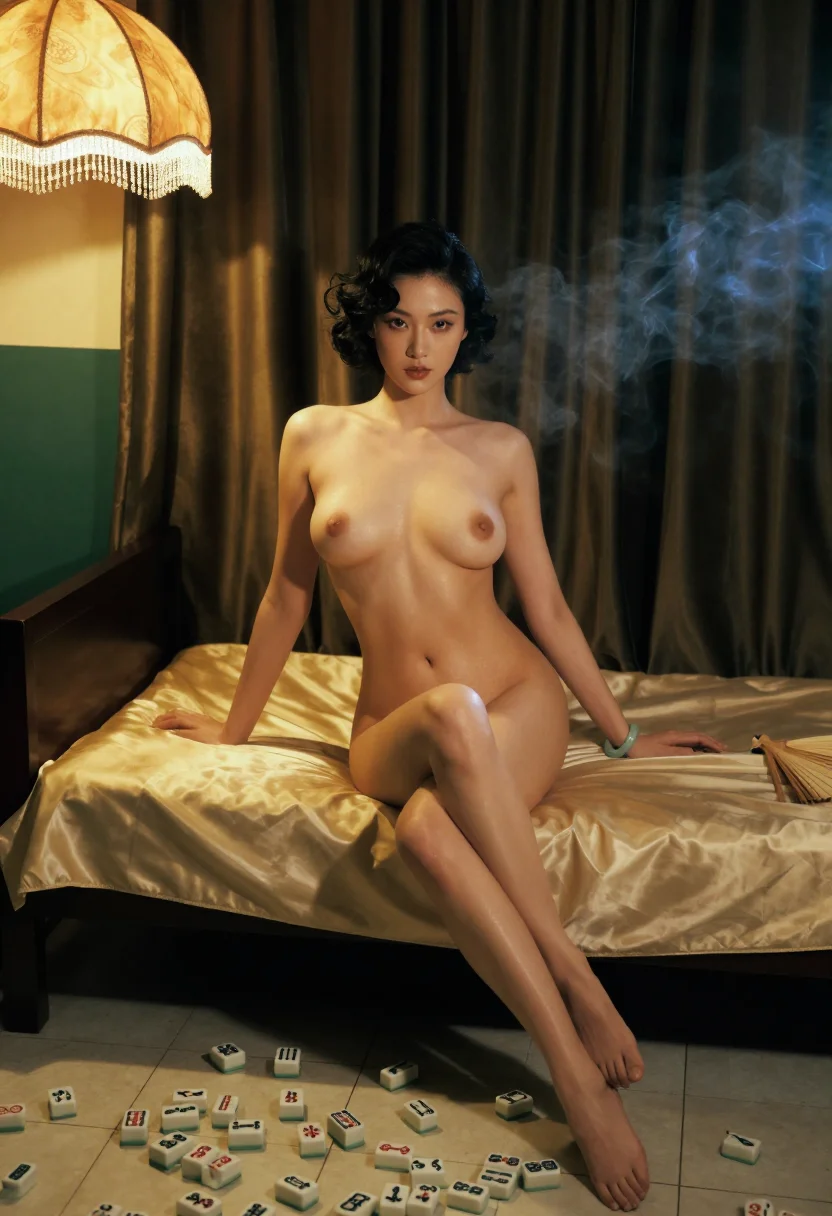
The 1930s mahjong parlour's back room is where the game ends, behind a curtain the click of tiles barely reaches, and the daybed is exactly where it stops. These nine frames follow that ending in order: pale silk at the table with the game still running, the cheongsam fastened at the frogs before the back room's mirror next, then the daybed with the tiles scattered on the floor beside it.
Cigarette smoke and lamp light carry the table frames in visible layers; a fringed shade warms the mirror room to amber; the daybed closes the sequence under that same fringed lamp with the curtain drawn and the parlour's clicking tiles just audible through it. A jade bangle worn throughout and a radio's faint glow keep the parlour lived-in rather than staged.
The set holds for the wider 1930s shanghai, shanghai boudoir, mahjong table, daybed and jade bangle register too: nothing in these nine frames was lifted off a real photograph of a real parlour. Each is written before it is rendered — the tiles, the smoke, the daybed — and composed from the first pixel forward. All nine are photographic in construction and AI-generated in execution; no real person was photographed to produce any of them.
Frequently asked questions
- What's in the Mahjong Parlour pack?
- Nine frames across one closed parlour: three at the mahjong table in a cheongsam of pale silk with a folded fan on the felt and cigarette smoke hanging in the lamp light, three in the back room before the mirror with the high collar and frogs fastened from collar to hip, and three on the parlour's daybed behind the curtain, tiles scattered on the floor beside it. Three frames per stage, one payment for the set.
- Does this work from an existing photo of someone?
- No. Nothing is generated by altering an existing image, because no existing image is read. Each frame is written first — the tiles, the cigarette smoke, the fringed lamp, the drawn curtain — then composed by the model from the first pixel forward. It is not something performed on a real photograph of a real person.
- Are these real photographs or AI-generated?
- AI-generated, built on photographic principles. Lamp light hangs the parlour's smoke in visible layers; a fringed shade warms the back room to amber; the mirror gives the daybed's edge back in soft reflected light. It reads as a parlour photograph, not an illustration.
- What are the three stages of the parlour?
- Table — pale silk cheongsam, a folded fan set on the felt beside the tiles, one hand resting on the ivory row, a jade bangle at the wrist. Mirror — the cheongsam fastened at the frogs from collar to hip, one hand on the mirror's frame, the jade bangle still on. Daybed — resting behind the curtain, tiles scattered on the floor, one arm along the daybed's raised end.
- What's the wardrobe?
- A pale silk cheongsam as the parlour's own evening dress, a jade bangle the one ornament that carries through every stage, worn even on the daybed.
- How is this different from the Cheongsam Tailor and Hong Kong Stairwell cheongsam packs?
- Mahjong Parlour is the 1930s Shanghai register — tiles, cigarette smoke, a curtained back room, no shop or tenement anywhere in it. Cheongsam Tailor is the pinned fitting itself; Hong Kong Stairwell moves the silhouette three decades forward into a rainy tenement stairwell instead of a parlour.
- How is this different from an AI chat or prompt box?
- A chat is a conversation you steer one turn at a time; a prompt box is something you refine image by image. This is a pre-engineered nine-frame series — one parlour, three stages, the smoke throughout — delivered whole for one payment. Better for a coherent set, worse if you want to negotiate every frame.
- Do I need to upload a selfie?
- It's optional. One clear front-facing photo casts the muse in your likeness across all nine frames; skip it and the house casts its own. Your selfie steers the face — it is never a photo that gets altered.
- Is there an age requirement?
- Access requires confirming you are 18 or over. The muse is composed from a written brief rather than photographed, so she is not a real person; if you cast your own face into the set, that likeness is yours and yours only.
- Who is in the photos?
- A muse you choose. 32 AI faces, none of them a real person.
Who Reaches for the Mahjong Parlour Register
- People searching for a mahjong parlour photoshoot who want the 1930s Shanghai back room, not a generic gambling-den set
- Photographers studying how cigarette smoke and a fringed lamp shade layer light differently across two rooms
- Costume and jewellery people looking at how a pale cheongsam and a jade bangle carry through a full sequence
- Writers and worldbuilders who need one consistent character across a single game's ending
- Anyone building a 1930s shanghai moodboard that has to hold one grade across nine images
- Collage artists who need photographic-quality smoke-and-lamp material rather than studio glamour
- Adults curious about the shanghai-parlour register of AI photography at an accessible entry price
- Fans of the mahjong table aesthetic who want the curtained-back-room version rather than the table itself
About Ovid
Ovid is a house of pictures that were never taken. Most AI image tools ship one giant catalog of poses and aesthetics; the output looks like every other generated image on the internet. Ovid goes the other way. Each pack is a single editorial brief — light, styling, scene composed in the grammar of the great fashion editorials — hand-curated against real references and tested before it ships. Free preview before you pay. Packs are one-time. No template generator, no feed. A fashion house, not a catalog.