/medusa
AI Medusa Muse — Nine Photos
Make it with your museAI Medusa Muse — Nine Photos
Open this world on the wall, and make it with your muse.
all 9 frames of her, in this world ↓
The Gorgon Register: Serpent Hair, Cracked Marble, Noon Light
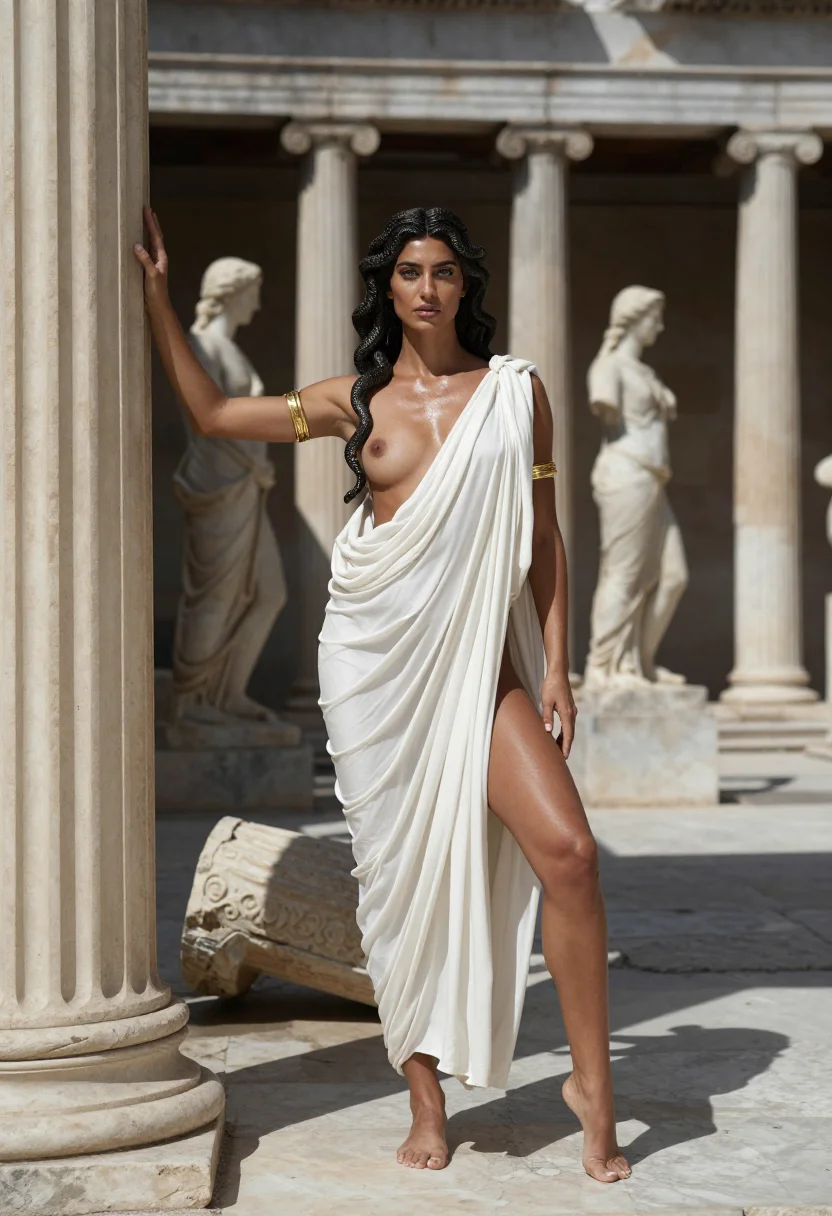
The Medusa myth is usually told as a warning; this pack tells it from the inside — the gorgon at ease in her own ruin, the one no man survives looking at, unbothered by the marble figures she left behind. The register is not horror but ownership: a fallen temple that belongs entirely to her, serpent hair worn the way another woman might wear a crown.
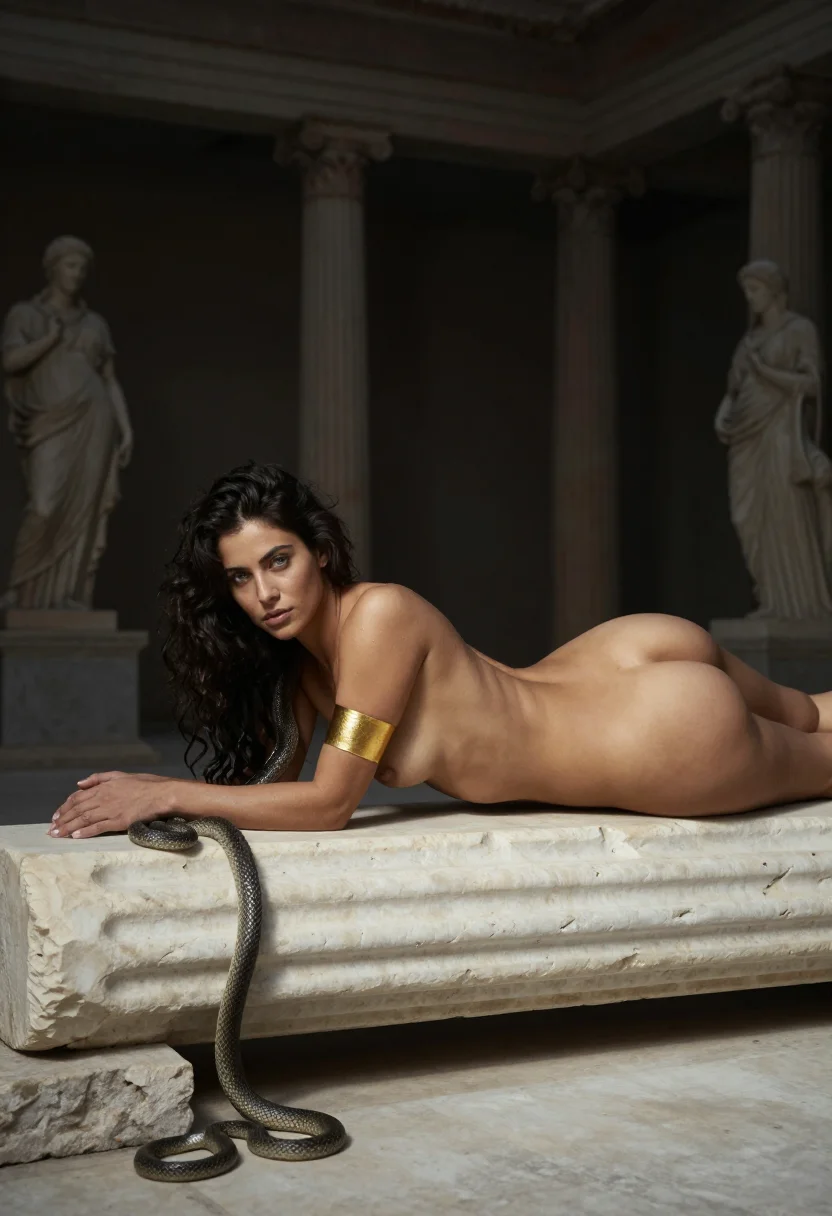
Three scenes carry the sequence, and the light stays hard and unforgiving throughout, noon sun through a roofless nave. It opens on the cracked marble floor, a white chiton pinned at one shoulder, the serpent hair lifting and coiling from her scalp in slow curves against a fallen column. It moves to the temple's top step, the chiton gathered at the waist, seated with her weight back on one hand, the serpents settled across both shoulders and catching the light. It closes on the fallen column itself, reclining in a single shaft of sun, the serpents at rest, hip and shoulder lit hard against the dim nave.
The serpent hair is named once per frame as an attachment — hair, not extra limbs — and the petrified marble figures stay faceless and turned away throughout, dust hanging visible in the light. Nothing here is lifted from a real photograph: every frame is written before it is rendered, temple and serpents and light built from the first pixel forward.
The house casts a range of muses through this myth — pale skin against warm marble, deep bronze catching the noon glare, dark hair heavy under the serpent coils. Every frame renders photographically: real stone-cool color against warm skin, real hard shadow through a broken roof, real dust suspended in a shaft of light. Nine frames read as one continuous visit to a single ruined temple, not three unrelated scenes.
Frequently asked questions
- What is in the AI Medusa Muse pack?
- Nine frames in one ruined gorgon temple: standing beside a fallen column on the cracked marble floor, seated on the temple's top step with the serpent hair settled over both shoulders, and reclining along the fallen column in a single shaft of hard noon light. Three frames per setting, one continuous temple.
- Does this pack edit or alter a real photograph?
- No. Nothing is lifted from an existing image, because no existing image is read. Each frame is written first — the chiton, the serpent hair, the marble, the light — and composed from the first pixel forward. Medusa is not a real person; if you upload a selfie, that likeness is yours by choice, cast into a muse who was written before she was rendered.
- Are these real photographs or AI-generated?
- AI-generated, built on photographic principles. Hard noon light through a roofless nave throws a sharp shadow edge; dust hangs visibly in the shaft; marble reads with real cool stone tone against warm skin. It reads as a photograph of a real ruin, not as an illustration.
- How is this different from the Siren pack?
- Siren is coastline and salt water — rocks, a tide pool, a moonlit wreck. Medusa is dry stone and noon heat: a fallen temple, marble figures turned away, serpent hair instead of a tail. Both are Greek-adjacent myth; the register and the element are opposite.
- What if my photo isn't great?
- The pack works with an ordinary phone selfie — front-facing, decent light, nothing professional required. The free preview shows the result on your own face before you pay anything.
- What are the three settings in this pack?
- Temple Floor — a white chiton pinned at one shoulder, standing beside a fallen column in hard noon light, dust in the air. Top Step — seated with the serpent hair over both shoulders, the chiton gathered at the waist, a shaft of sun on the collarbones. Fallen Column — resting along the column's length in the single shaft of light, the serpents at rest, the nave dim around her.
- How is this different from an AI chat or prompt box?
- A chat is a conversation you steer; a prompt box is refined one frame at a time. This is a pre-engineered nine-frame series — one temple, three scenes — delivered whole for one price.
- Can I use the frames once unlocked?
- Personal and creative use. Not for commercial redistribution, not to present as a real person's photograph, and not for use against any individual.
- Is there an age requirement?
- Access requires confirming you are 18 or older. The muse is composed from a written brief, not photographed; if you cast your own face into the set, that likeness is yours and yours only.
- Who is in the photos?
- A muse you choose. 32 AI faces, none of them a real person.
Who Reaches for the Gorgon Register
- Anyone searching medusa or a gorgon photoshoot who wants the myth composed rather than scavenged
- People who want a coherent nine-frame set across one ruined temple instead of one-off prompt results that never match
- Fans of Greek mythology looking for the gorgon told from her own point of view, not as a monster
- Photographers studying hard noon light through a roofless structure and how it falls on marble and skin
- Writers and worldbuilders needing a consistent muse for a Greek-myth storyline
- Readers of the Siren pack looking for a second, dry-stone myth register
- Collage and moodboard artists who need photographic-quality ruin material rather than studio glamour
- Adults curious about AI mythological photography at an accessible entry price
About Ovid
Ovid is a house of pictures that were never taken. Most AI image tools ship one giant catalog of poses and aesthetics; the output looks like every other generated image on the internet. Ovid goes the other way. Each pack is a single editorial brief — light, styling, scene composed in the grammar of the great fashion editorials — hand-curated against real references and tested before it ships. Free preview before you pay. Packs are one-time. No template generator, no feed. A fashion house, not a catalog.