/nude-selfie
AI Mirror Selfies — Three Rooms
Make it with your museAI Mirror Selfies — Three Rooms
Open this world on the wall, and make it with your muse.
all 9 frames of her, in this world ↓
The Mirror Selfie Register: No Set, No Stylist, One Phone
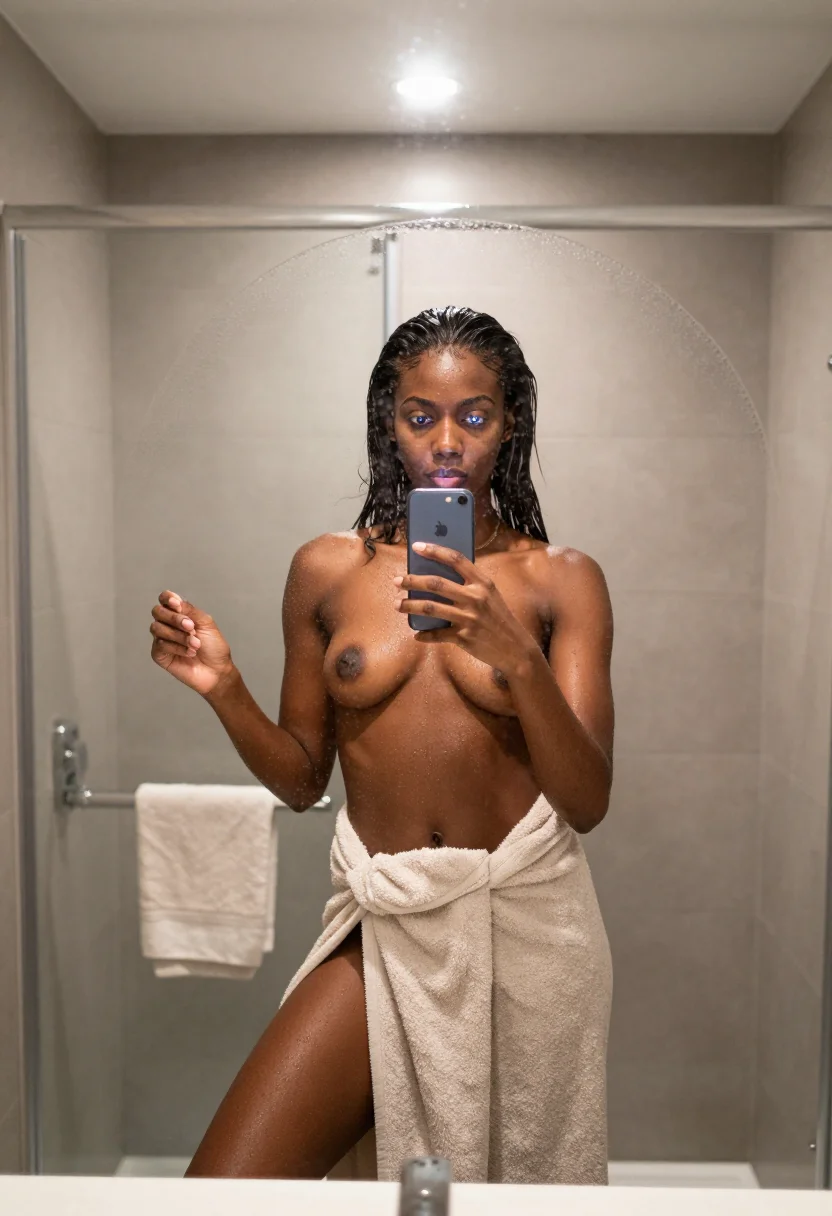
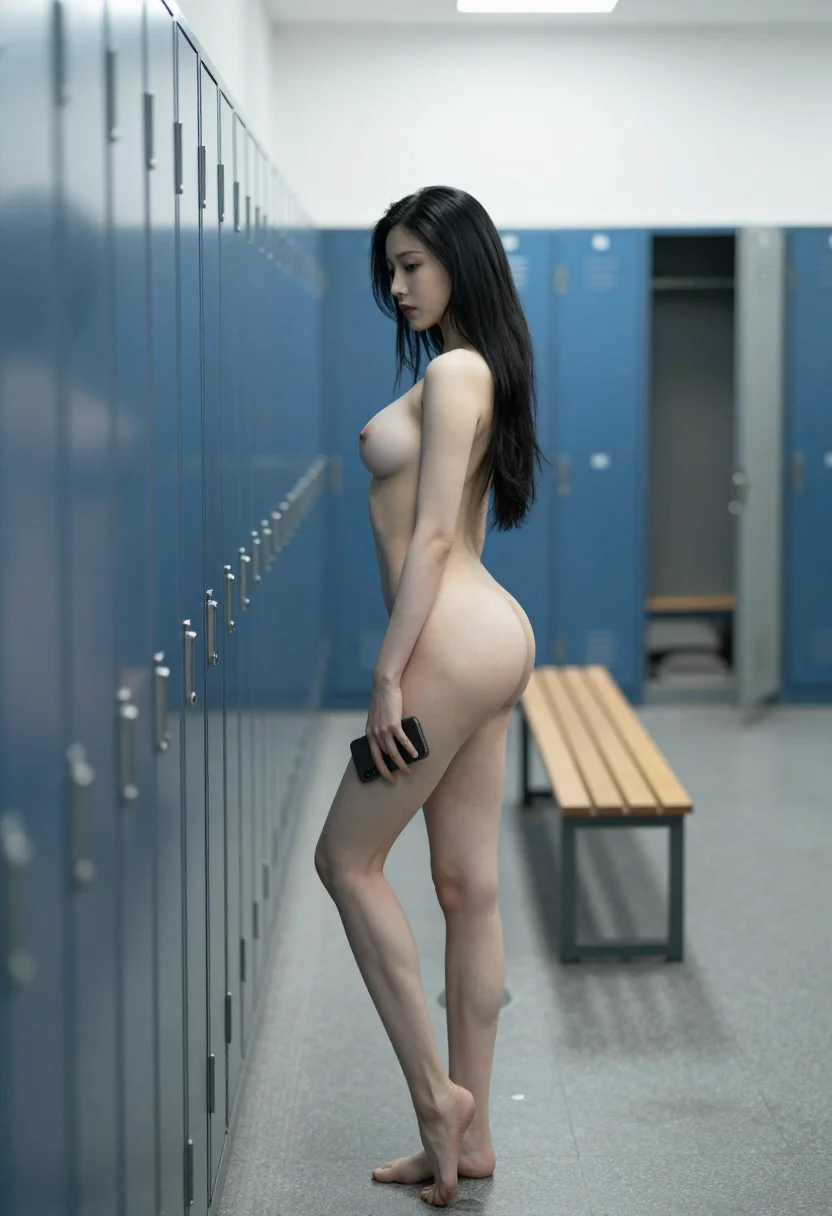
This is the plainest thing in the house. No costume, no era, no narrative hook — a muse, a mirror and a phone, in three of the places where a mirror selfie actually gets taken. A bathroom still fogged from the shower, with an arc wiped clean through the condensation and a towel held at hip height. A bedroom floor in front of a full-length mirror, fairy lights strung along the headboard behind. An empty gym locker room between a bank of steel-blue lockers and a slatted bench, a duffel bag open on the rubber floor. The self shot at face value, with nothing added to make it an occasion.
What varies is the light, and it varies more than a studio ever would. The bathroom is bright and open: a broad even white glow spilling from the ceiling recess over the bath, near and large so the shadow under the jaw stays gradual, the phone's own burst blooming back off the fogged glass, wet tile and a beaded screen throwing scattered speculars. The bedroom inverts it — a low warm bedside glow from camera-right and slightly below, small and close, cutting a crisp edge along the ribs, the strung lights behind opening the shadow side into a field of round highlights while everything else falls dark. The locker room is the coldest and hardest of the three: a small far overhead running the aisle, a crisp shadow under the collarbone, the lit planes standing bright out of a dark ground, locker doors throwing hard speculars.
Each photo is written before it is rendered — the room, the pose, the source of light, the water still beaded on the collarbone — and composed from the first pixel forward. The amateur selfie is a look, not an accident, and this pack builds it deliberately: the phone visible in the reflection or propped against the glass, the framing a little arbitrary, the pose held rather than posed, the light whatever the room had.
The ordinary marks stay in — tan lines, wet hair pushed back, the print of bench slats along a thigh, chalk dust on a gym floor. All nine photos are photographic in construction and AI-generated in execution, rendered from photographic principles rather than drawn or animated. No real person was photographed to produce any of them.
Frequently asked questions
- Who is the muse in the AI Mirror Selfies pack — is she real?
- She's an AI muse, generated from a written brief — no photograph is read and no one real stands behind her. Each photo is composed from the first pixel forward: the pose, the room, the source of light, the towel dropped to hip height.
- What is in the AI Mirror Selfies pack?
- Nine photos in three ordinary places, three photos each: a bathroom mirror still fogged from the shower with an arc wiped clean through the condensation, a bedroom full-length mirror with fairy lights strung along the headboard behind it, and the long mirror of an empty gym locker room. No costume, no narrative, no occasion. One payment unlocks the set.
- Are these real photographs or AI-generated?
- AI-generated, built on photographic principles. A broad ceiling bloom over a bath blooms back off fogged glass and keeps the shadow under the jaw gradual; a low warm bedside glow from below cuts a crisp edge along the ribs while strung lights behind it dissolve into round bokeh; a hard cold overhead in a locker aisle leaves the lit planes standing bright out of a dark ground. It reads as a phone photograph, not an illustration or an anime render.
- How is this different from the Mirror Selfie pack?
- Mirror Selfie is one register held tight: raw on-camera flash, the amateur selfie look, everything flattened by the burst. This pack spreads out instead — three situations with three genuinely different light sources, from a bright fogged bathroom to a dark fairy-lit bedroom to a cold locker aisle. If you want the hard-flash look, that pack is the better buy. If you want the mirror selfie as it actually varies room to room, this one is.
- How is this different from the Front Camera pack?
- Front Camera has no mirror in it — the phone is held at arm's length above her own face and the camera is the front lens. Here the mirror is the camera in every photo and the phone appears inside the reflection, propped against the glass or held flat against a thigh. Two different self shot grammars: one looks into the lens, the other looks into the glass.
- How is this different from the Gym Flash pack?
- Gym Flash is on the gym floor mid-set, a sports bra and leggings. The locker room here is what happens after: an empty aisle, a duffel bag open on the rubber floor, a towel round her hips, the sports bra hanging from one fist. Same building, different moment, and only one of them has a mirror in it.
- What are the three settings?
- Fogged Bathroom — warm grey stone tile, a beaded glass shower screen, a broad white ceiling bloom, an arc wiped clean through the condensation. Fairy-Lit Bedroom — a rug in front of a full-length mirror, a rumpled linen duvet, a low bedside glow and strung lights going to round bokeh. Gym Locker Room — steel-blue lockers down an aisle, a slatted bench, chalk dust on the floor, a hard cold overhead. This is the gym locker selfie and the bathroom mirror selfie in the same pack.
- Why does the skin look different from a studio shoot?
- Because the ordinary details are kept on purpose. Water stands in beads across a collarbone and runs in thin lines down a spine; pale tan lines cross the shoulders and hips against darker skin; bench slats print faint lines along the back of a thigh; wet hair is pushed back off a forehead or wound up in a towel. A tan lines portrait reads real for exactly these reasons, and a studio shoot removes all of them.
- How is this different from an AI chat or prompt box?
- Different shape. A chat is a conversation you steer; a prompt box is something you refine one image at a time. This is a pre-engineered nine-photo series — three rooms, three lighting logics, one coherent grade — delivered whole for a single payment. Better for a consistent set, worse if you want to negotiate every photo.
- Can I use the photos once unlocked?
- Personal and creative use. Not for commercial redistribution, not to present as a real person's photograph, and not for use against any individual.
- Is there an age requirement?
- Access requires confirming you are 18 or over. The muse is composed from a written brief rather than photographed, so she is not a real person.
- Who is in the photos?
- A muse you choose. 32 AI faces, none of them a real person.
Who Reaches for the Mirror Selfie Register
- Anyone who wants the ordinary register rather than a themed shoot — no costume, no set, no occasion in any of the nine photos
- People whose search was a mirror pic and who want the format itself, phone in the reflection included
- Photographers studying how a broad ceiling bloom, a low warm bedside glow and a hard cold overhead each read on the same subject
- Artists who want the marks a studio removes — tan lines, water beads, bench-slat prints, wet hair
- Writers and worldbuilders who need one consistent face for a character across three ordinary rooms
- Anyone assembling an amateur-register moodboard that has to hold one grade across nine images
- Adults curious about AI photography in its plainest form at an accessible entry price
About Ovid
Ovid is a house of pictures that were never taken. Most AI image tools ship one giant catalog of poses and aesthetics; the output looks like every other generated image on the internet. Ovid goes the other way. Each pack is a single editorial brief — light, styling, scene composed in the grammar of the great fashion editorials — hand-curated against real references and tested before it ships. Free preview before you pay. Packs are one-time. No template generator, no feed. A fashion house, not a catalog.