/pharaohs-bedchamber
AI Pharaoh's Wife Muse — Nine Photos
Make it with your museAI Pharaoh's Wife Muse — Nine Photos
Open this world on the wall, and make it with your muse.
all 9 frames of her, in this world ↓
The Bedchamber Register: One Lamp, Gold, and a Linen Canopy
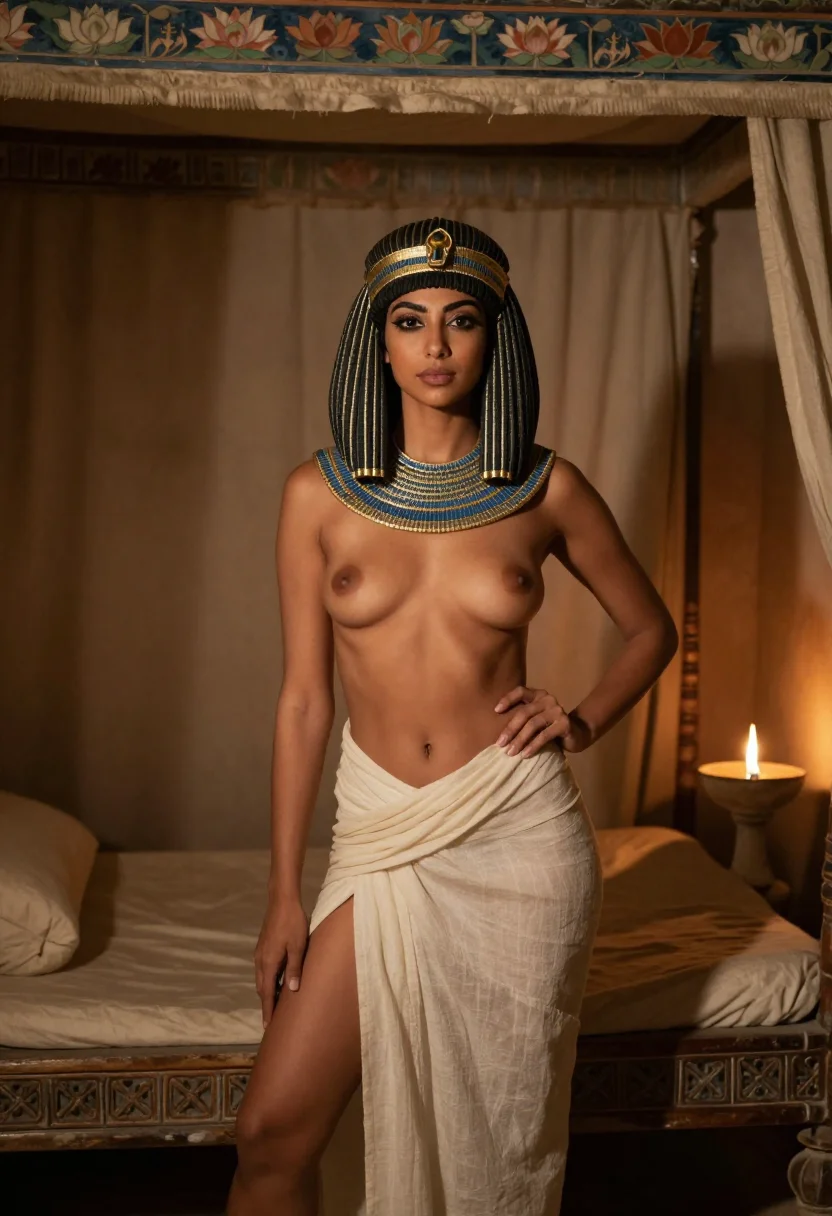
The painted bedchamber is the innermost room of the palace, and the pack treats it as exactly that: the place where the ceremony of an Egyptian court finally stops. A low bed with a carved footboard and an ivory headrest, a linen canopy gathered on its posts, a wig on its stand, a broad beaded collar, gold anklets, an alabaster bowl with one flame in it, and walls painted with lotus and papyrus in blue and ochre. Nothing in the room is public. The pharaoh's wife here is licensed by the architecture — this is the room fine linen was always going to be loose in.
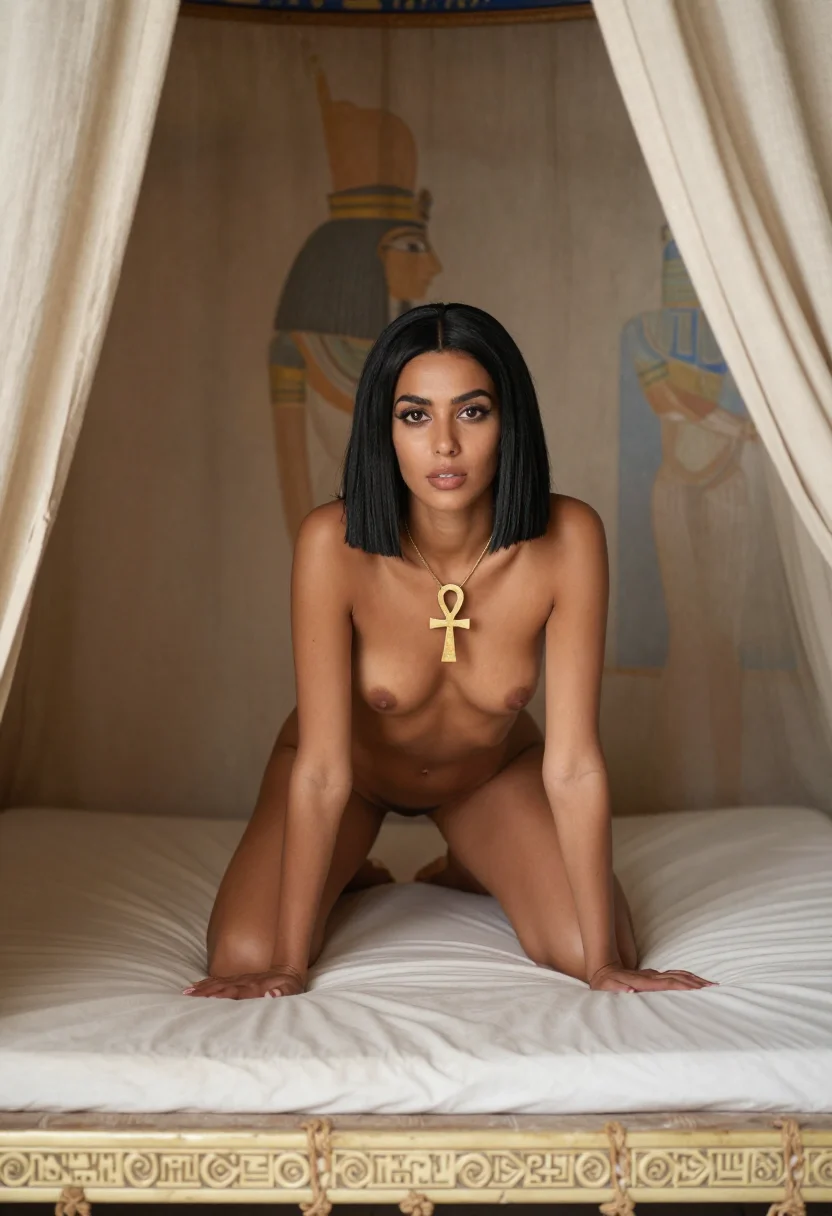
Three lighting conditions carry the nine frames, and the canopy is what moves between them. The opening third is the hardest: the lamp sits near and open beside the bed, so the collar's beads and the anklets' gold throw crisp speculars, the painted wall holds its saturation, and the shadow along the ribs runs long and gradual. The middle third turns that source across the bed itself, catching the headrest's curve and the wig's dark mass on its stand. The last third is the softest in the pack — the canopy is let down, and the same small flame reaches her only through gauze, arriving broad and white, with the wall's colours reduced to a warm blur beyond.
The wardrobe moves one step per third and never lands halfway. In the first frames the linen is worn, slipping from one shoulder and held at the hip. In the middle frames it lies over the footboard and the gold stays on. In the last frames she is wrapped in fine linen with the ankh amulet on its cord, and the point of those frames is the canopy's gauze.
The pose craft holds across all nine. A hand rests on the footboard, on the headrest's curve, or on the hip; the reclining frames are framed from the head end at three-quarters so the figure reads along its length rather than toward the lens; no limb is pointed at the camera in any frame. The muse is unambiguously an adult woman throughout.
All nine frames are photographic in construction and AI-generated in execution — specular on beaten gold, the soft shadow edge of a diffused flame, linen and plaster and ivory rendered from photographic principles rather than drawn or painted. The New Kingdom is borrowed here for its furniture and its palette; nothing in the set documents a real room or a real woman.
Frequently asked questions
- What is in the AI Pharaoh's Wife pack?
- Nine frames in one painted bedchamber, in three states. Standing: a wig and a broad beaded collar, the linen slipping from one shoulder and held at the hip, one hand on the bed's carved footboard, the ivory headrest behind her and lotus and papyrus painted across the wall. Reclining: the linen laid over the footboard, gold anklets and the collar on, one elbow down and the other hand resting on the headrest's curve, the wig set on its stand beside the bed. Behind the canopy: wrapped in fine linen with an ankh amulet on its cord, the canopy let down around the bed, framed from the head end through the gauze. Three frames per state, one payment for the set.
- Are these real photographs or AI-generated?
- AI-generated, built on photographic principles. A single lamp flame in an alabaster bowl is a small warm source with a soft falloff — it puts a hard specular on the collar's beads and the anklets' gold, and a long gradual shadow along the ribs. The gauze of the canopy turns that same flame into a broad white wash in the last third. Linen, plaster, ivory and beaten gold each answer the light differently. It reads as a photograph made in that room, not as an illustration of one.
- Why is the bedchamber the right room for this?
- Because it is the one room the palace kept for itself. Everything else in an Egyptian court was ceremony — the audience hall, the temple, the river procession — and the bedchamber behind them had no audience at all. The linen there is worn loose because there is nobody to wear it for, which is what makes the egyptian queen portrait a matter of architecture rather than of pose.
- What is she wearing across the nine frames?
- A plaited wig and a broad beaded collar in the opening third, with fine linen slipping from one shoulder and held at the hip. In the middle third the linen lies over the carved footboard and the gold stays on — anklets, the collar, a band at the arm. In the last third an ankh amulet on its cord is the only thing left, and the wig sits on its stand beside the bed as a dark shape beyond the gauze. Every frame is a settled state; nothing is ever caught halfway between two of them.
- How is this different from the Hieroglyph Paint pack?
- Hieroglyph Paint is the temple side of the same century: gold and lapis bands painted straight onto the skin, a sandstone relief, a pool that washes half the paint away. This one is domestic and private — a low bed, a lamp, a canopy, and linen rather than pigment. If you want the painted body, start there; if you want the bedchamber, start here.
- Is the Egyptian setting historically accurate?
- Period-shaped rather than museum-exact. The low bed with its carved footboard, the ivory headrest, the broad collar, the alabaster lamp and the lotus-and-papyrus wall are drawn from New Kingdom furnishing and painting; the pack borrows that register for its light and its props. No hieroglyphic text is legible anywhere in the set, deliberately — the walls carry pattern and colour, not a claim to say anything.
- Why does the light soften through the set?
- Because the canopy comes down. The first frames are the crispest in the pack — the lamp is small, near and open, so gold reads hard-edged and the painted wall's blue and ochre stay saturated. The middle third keeps that source but turns it across the bed. In the last third the linen canopy is let down and the same flame arrives diffused and white through the gauze, the anklets dimmed to a glow, the painted wall softened behind.
- Do I need to upload a selfie?
- It is optional. One clear front-facing photo casts the muse in your likeness across all nine frames; skip it and the house casts its own. Your selfie steers the face only — it is never the image being worked on.
- How is this different from an AI chat or prompt box?
- A chat is a conversation you steer; a prompt box is something you refine one image at a time. This is a pre-engineered nine-frame series — one room, three states, three lighting conditions — delivered whole for one payment. Better if you want a coherent set, worse if you want to negotiate every frame.
- Can I use the frames once unlocked?
- Personal and creative use. Not for commercial redistribution, not to present as a real person's photograph, and not for use against any individual.
- Is there an age requirement?
- Access requires confirming you are 18 or over. The muse is an adult woman composed from a written brief rather than photographed — she is a synthetic archetype, not a real person and not a depiction of any living or historical individual, and the pharaoh's wife here is a costume register rather than a named queen. If you cast your own face into the set, that likeness is yours by your own choice and yours alone.
- Who is in the photos?
- A muse you choose. 32 AI faces, none of them a real person.
Who Reaches for the Bedchamber Register
- People searching an egyptian queen photoshoot who want the private room rather than the throne or the temple
- Anyone building an ancient egypt set that has to hold one room and one grade across nine images
- Photographers studying what a single small flame does across gold, beads and linen at close range
- Costume and jewellery people looking at how a broad collar, anklets and fine linen sit on a body rather than on a mannequin
- Writers and worldbuilders who need one consistent character through a single evening in one palace room
- Collage and moodboard makers who need photographic-quality bedchamber material rather than studio glamour
- Boudoir readers who want a period interior with its own light rather than a hotel room
- Adults curious about the historical register of AI photography, in lamp light rather than a softbox
About Ovid
Ovid is a house of pictures that were never taken. Most AI image tools ship one giant catalog of poses and aesthetics; the output looks like every other generated image on the internet. Ovid goes the other way. Each pack is a single editorial brief — light, styling, scene composed in the grammar of the great fashion editorials — hand-curated against real references and tested before it ships. Free preview before you pay. Packs are one-time. No template generator, no feed. A fashion house, not a catalog.