/wasteland-raider
AI Wasteland Raider Photos
Make it with your museAI Wasteland Raider Photos
Open this world on the wall, and make it with your muse.
all 9 frames of her, in this world ↓
The Wasteland Register: Dust, Leather, and a Road Going Nowhere
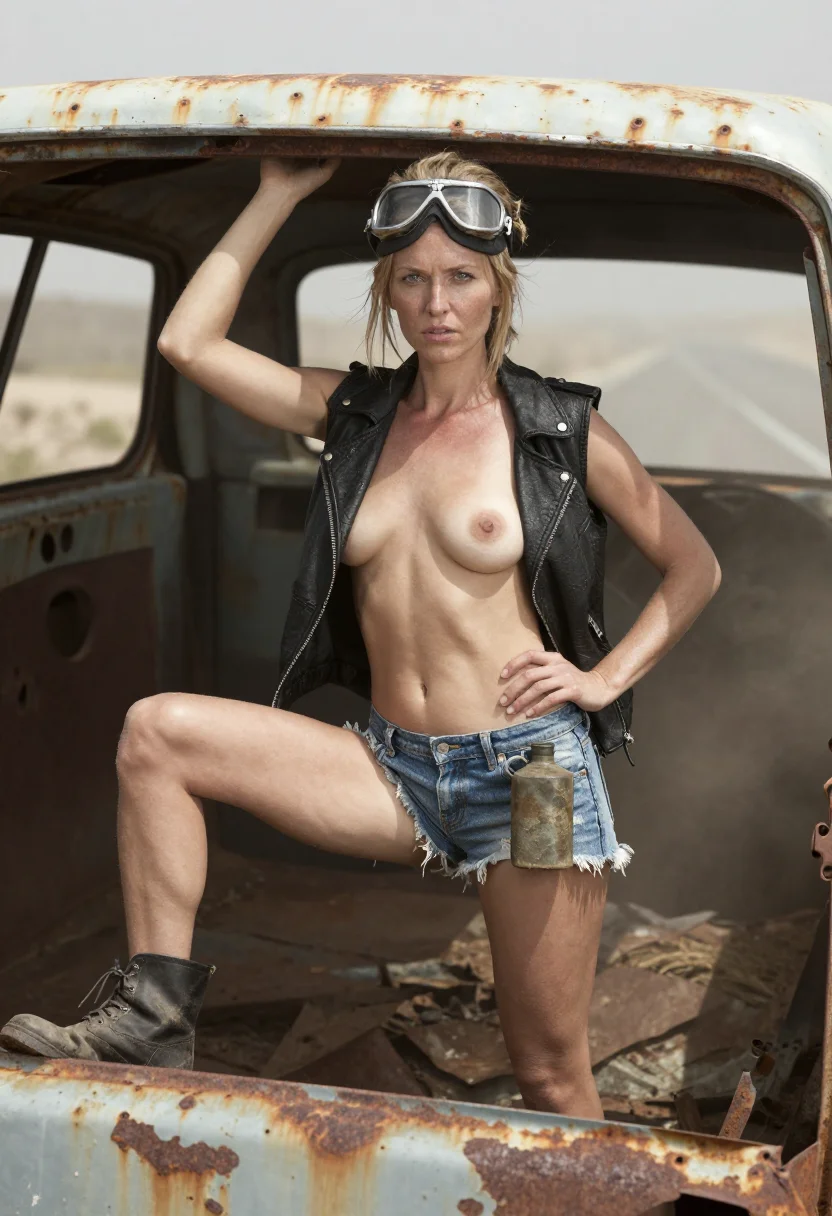
This is the road after everything — a rusted car husk, a dead tanker throwing the only shade for miles, and an empty stretch of tarmac running straight into the sun. The raider is alone in every frame and dressed the way the road dresses: a leather vest worn open over a grey tank, cut-off shorts, boots, goggles, a canteen slung at the hip. Nothing about the register is seduction. It is heat, distance and the specific ease of a woman who has not seen another person in a week.
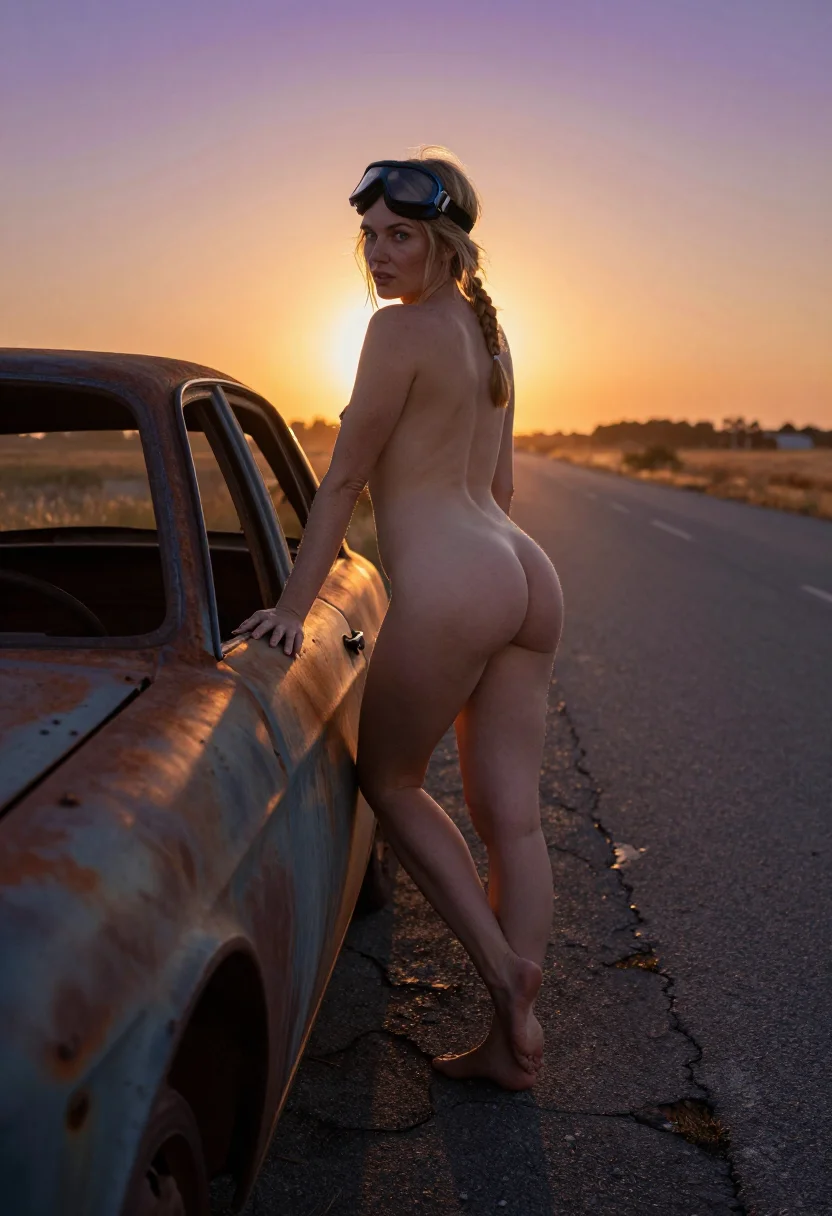
Three lights carry the sequence, and they run the length of one day. The first three frames sit under hard overhead sun that bleaches the wreck toward bone and drops a short unforgiving shadow beneath the jaw, with dust still hanging in the air behind her and heat shimmer coming off the metal. The middle three move into the tanker's shade, a cool blue with a sharp edge cut hard against the white glare beyond it, rust flakes on the sand and the road reduced to a grey line. The last three are sunset — low, long, gold, the sky going orange to violet and the settled dust catching the last of it while the empty road runs out toward the horizon.
The wardrobe loses a layer as the day goes. Vest worn open at the wreck, vest dropped in the sand at the tanker, and the tank and boots on the car's roof by the last light with the goggles pushed up into her hair. The wreck and the tanker carry no plates and no lettering: this road belongs to nobody and names nothing.
The house casts a range of muses through this register — pale skin going pink under the overhead sun, deep bronze holding the sunset's gold, hair dusty and off her face throughout. Every frame renders photographically: real specular bounce off dented steel, real sand grain, real leather sheen, real heat haze. Nothing here was lifted from a photograph of anyone. Each frame is written before it is rendered — the wreck, the hour, the source of light, the canteen in the sand — and composed from the first pixel forward.
Frequently asked questions
- What is in the AI Wasteland Raider Photos pack?
- Nine frames along one dead road. Three at a rusted car husk under hard overhead sun — goggles down, a leather vest worn open over a grey tank, cut-off shorts and boots, one foot up on the wreck's sill. Three in the shade under a dead tanker, the vest dropped in the sand, a canteen tipped to her mouth. Three on the car's roof at sunset, lying back on dented steel with the road running straight into the sun.
- Does this pack edit or alter a real photograph?
- No. Nothing is lifted from an existing image, because no existing image is read. Each frame is written first — the wreck, the vest, the angle of the sun, the dust still hanging — and composed from the first pixel forward. The raider is not a real person; if you upload a selfie, that likeness is yours by choice, cast into a muse written before she was rendered.
- Are these real photographs or AI-generated?
- AI-generated, built on photographic principles. Overhead sun bleaches the wreck toward bone white and drops a short hard shadow under the jaw; the tanker's shade is a sharp cool-blue edge cut across a white glare; sunset light is low and long and turns the settling dust to gold. Leather, cotton, rust and sand each answer that light differently. It reads as a photograph taken on a real road, not an illustration.
- What are the three settings?
- The Wreck — a rusted car husk in full overhead sun, dust hanging in the air behind her, heat shimmer off the metal. The Tanker's Shade — a dead tanker's rear tyre, cool blue shade against white glare, rust flakes on the sand, the road a grey line beyond. The Roof at Sunset — the car's dented roof with an empty road running to the horizon, the sky going orange to violet, the vest and canteen down in the sand below.
- Why does the vest come off during the set?
- Because the road dresses that way. Layers come and go with the heat, and there is nobody for a hundred miles to dress for — the vest is on in the first frame, dropped in the sand in the second, and left there in the third. The register is solitude rather than performance: nine frames of a woman alone with a wreck, a canteen and a dead road.
- What is she wearing across the nine frames?
- A worn leather vest over a grey tank, cut-off shorts, heavy boots, dust goggles and a slung canteen. The goggles come up into her hair after the first three frames and stay there; the boots stay on in the last frame. Nothing on the wreck or the tanker carries plates or lettering — the road is anonymous by design.
- How is this different from the Desert Planet pack?
- Desert Planet is another world — a sand-coloured still suit, dune crests under a planetary sun, and a cave that is the only cool room for a thousand miles. This one is Earth after the fact: rust, petrol, boots, a wreck somebody once drove. Same heat, same solitude, opposite century.
- What if my photo isn't great?
- The pack works with an ordinary phone selfie — front-facing, decent light, nothing professional required. The free preview shows the result on your own face before you commit to anything.
- What does the road look like?
- A dead road with a rusted car husk, a dead tanker throwing the only shade for miles, and an empty stretch of tarmac running into the sun. One road, three hours of light — delivered whole in one go.
- Can I use the frames once unlocked?
- Personal and creative use. Not for commercial redistribution, not to present as a real person's photograph, and not for use against any individual.
- Is there an age requirement?
- Ovid is for adults 18+, and access requires confirming you are 18 or older. The muse is composed from a written brief rather than photographed, so she is not a real person; if you cast your own face into the set, that likeness is yours and yours only.
- Who is in the photos?
- A muse you choose. 32 AI faces, none of them a real person.
Who Reaches for the Wasteland Register
- Anyone searching wasteland girl or post apocalyptic portraits who wants the register composed rather than scavenged
- People who want a coherent nine-frame set across one location instead of one-off prompt results that never match
- Fans of road-movie and end-of-the-world imagery looking for it rendered as photography rather than illustration
- Photographers studying hard overhead sun against sharp-edged shade and a low gold sunset in one sequence
- Costume and wardrobe people looking at how worn leather, dust and sweat behave under desert light
- Writers and worldbuilders who need one consistent character across a single day on a dead road
- Fans of the Desert Planet pack looking for the Earth-after-the-fact counterpart to the still suit
- Collage and moodboard artists who need photographic-quality desert-wreck material rather than studio glamour
- Adults curious about the post apocalyptic register of AI photography at an accessible entry price
About Ovid
Ovid is a house of pictures that were never taken. Most AI image tools ship one giant catalog of poses and aesthetics; the output looks like every other generated image on the internet. Ovid goes the other way. Each pack is a single editorial brief — light, styling, scene composed in the grammar of the great fashion editorials — hand-curated against real references and tested before it ships. Free preview before you pay. Packs are one-time. No template generator, no feed. A fashion house, not a catalog.