/zero-g
AI Zero Gravity Photos
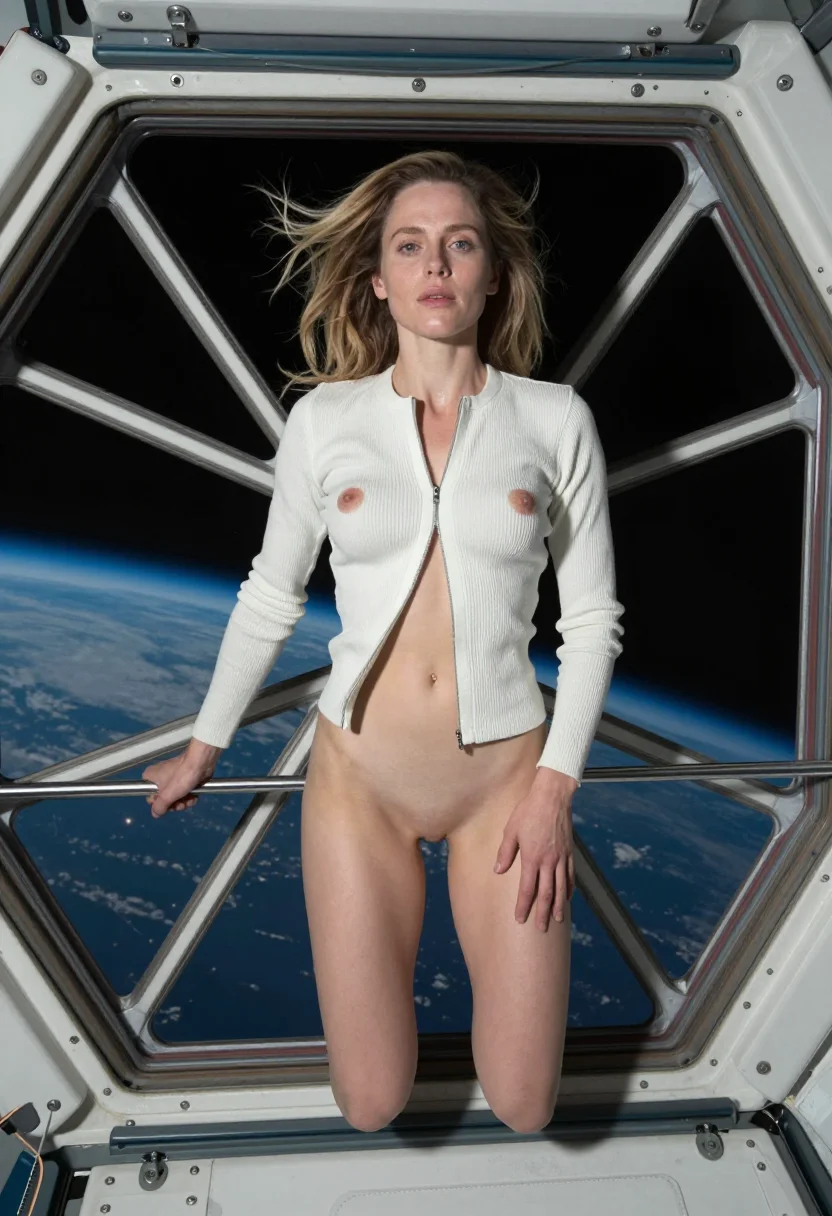
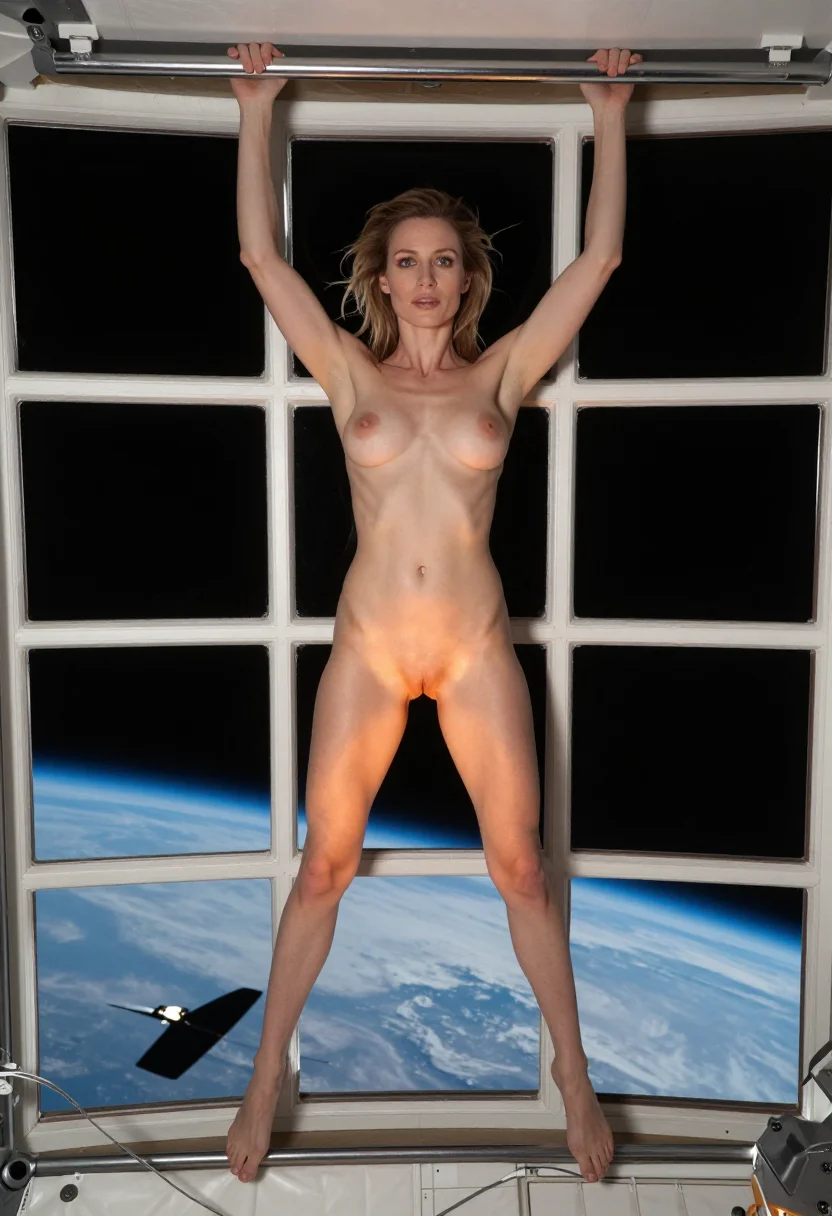
Make it with your museAI Zero Gravity Photos
Open this world on the wall, and make it with your muse.
all 9 frames of her, in this world ↓
The Zero Gravity Register: Hair Adrift, Earthlight on Skin
This is a body with nothing to hang from. In a station's cupola and berth, freefall does what a floor never could: hair lifts into a slow halo instead of falling, fabric drifts in a curl instead of a drop, and a body has to anchor itself to a rail or a wall or it simply turns in place. The register is not a costume for the camera — it is the physics of the room doing the work, and the muse alone with it, earthlight the only witness.
Two lights carry the sequence. The cupola runs on earthlight alone: a cool, indirect blue rising off the planet's limb, wrapping the arms and the underside of the jaw, the cupola's white frames cutting hard against black outside the panes. The berth runs warmer — a single clipped reading lamp gives directional side light across the shoulder and the drifting curve of the sleeping bag, cables and velcro patches catching soft highlight where the lamp reaches them and falling to near-black where it doesn't.
Every frame keeps one point of contact — a rail, a sill, the berth wall — as the only fixed thing in a room where everything else, hair included, obeys no floor. Composed from a written brief rather than photographed, each frame is built pixel by pixel for this exact register: photographic in construction, AI-generated in execution, no real person read or altered to produce it.
Frequently asked questions
- What is in the AI Zero Gravity Photos pack?
- Nine frames set aboard a station in true weightlessness: the seven-pane cupola window over the planet's blue limb, the sleeping-bag berth with its velcro and coiled cables, and the cupola again at the close of the set, hair in full float and one foot hooked under the rail. Three frames per setting, one payment for the set.
- Are these real photographs or AI-generated?
- AI-generated, built on photographic principles. Earthlight reads blue and cool across the arms and the underside of the jaw; a clipped reading lamp gives warm, directional side light in the berth; the terminator's edge warms one thigh as the planet turns. Hair behaves like hair in freefall — lifted, drifting, never resting on a shoulder — because nothing in the frame obeys a floor. It reads as a station photograph, not as an illustration.
- Is this an AI tool that alters a real photo of me?
- No. Each frame is written first — the pose, the rail she's anchored to, the light source — and composed from the first pixel forward. Nothing is lifted from an existing image, because no existing image is read; weightlessness is part of the brief, not an operation performed on a real photograph.
- Why is she always holding a rail or the berth wall?
- Because nothing else keeps a body oriented in freefall. Every frame anchors her to a rail, a sill, or the berth wall as its ground plane — the one fixed thing in a room where everything else drifts, herself included.
- What are the two settings?
- Cupola — the seven-pane observation window over the planet's blue limb, rails below the panes, cables tethered along the rim, earthlight the only real light source. Berth — the sleeping-bag wall, velcro strips and coiled cables, a small clipped lamp giving warm side light, a pen and mirror on velcro patches.
- What does she wear across the set?
- A fitted thermal top and leggings with grey socks in the first frame; the same with a one-piece sleeping bag half-zipped and drifting round the waist in the second; the thermal top and leggings again by the close, hair the only thing still moving.
- Do I need to upload a selfie?
- It is optional. One clear front-facing photo casts the muse in your likeness across all nine frames; skip it and the house casts its own. Your selfie steers the face — it is never the image being altered.
- What does the station look like?
- A station's seven-pane cupola over the planet's blue limb, and a sleeping-bag berth strung with cables and velcro. One station, two rooms, one light source that turns with the planet — delivered whole for one payment.
- Can I use the frames once unlocked?
- Personal and creative use. Not for commercial redistribution, not to present as a real person's photograph, and not for use against any individual.
- Is there an age requirement?
- Ovid is for adults 18+, and access requires confirming you are 18 or over. The muse is composed from a written brief rather than photographed, so she is not a real person; if you cast your own face into the set, that likeness is yours and yours only.
- Who is in the photos?
- A muse you choose. 32 AI faces, none of them a real person.
Who Reaches for the Zero Gravity Register
- People whose search was zero gravity photos and who want the physics of freefall, not a studio floor
- Sci-fi worldbuilders needing a consistent astronaut character across a single weightless sequence
- Photographers studying how earthlight and a single clipped lamp read across skin with no shadow falling the usual way
- Costume and prop people looking at how a sleeping bag and thermal fabric drift instead of hang
- Writers building a station-set scene who need reference for hair and fabric behavior in freefall
- Collage artists assembling a coherent zero-g moodboard across nine frames at one grade
- Adults curious about the astronaut register of AI photography at an accessible entry price
About Ovid
Ovid is a house of pictures that were never taken. Most AI image tools ship one giant catalog of poses and aesthetics; the output looks like every other generated image on the internet. Ovid goes the other way. Each pack is a single editorial brief — light, styling, scene composed in the grammar of the great fashion editorials — hand-curated against real references and tested before it ships. Free preview before you pay. Packs are one-time. No template generator, no feed. A fashion house, not a catalog.